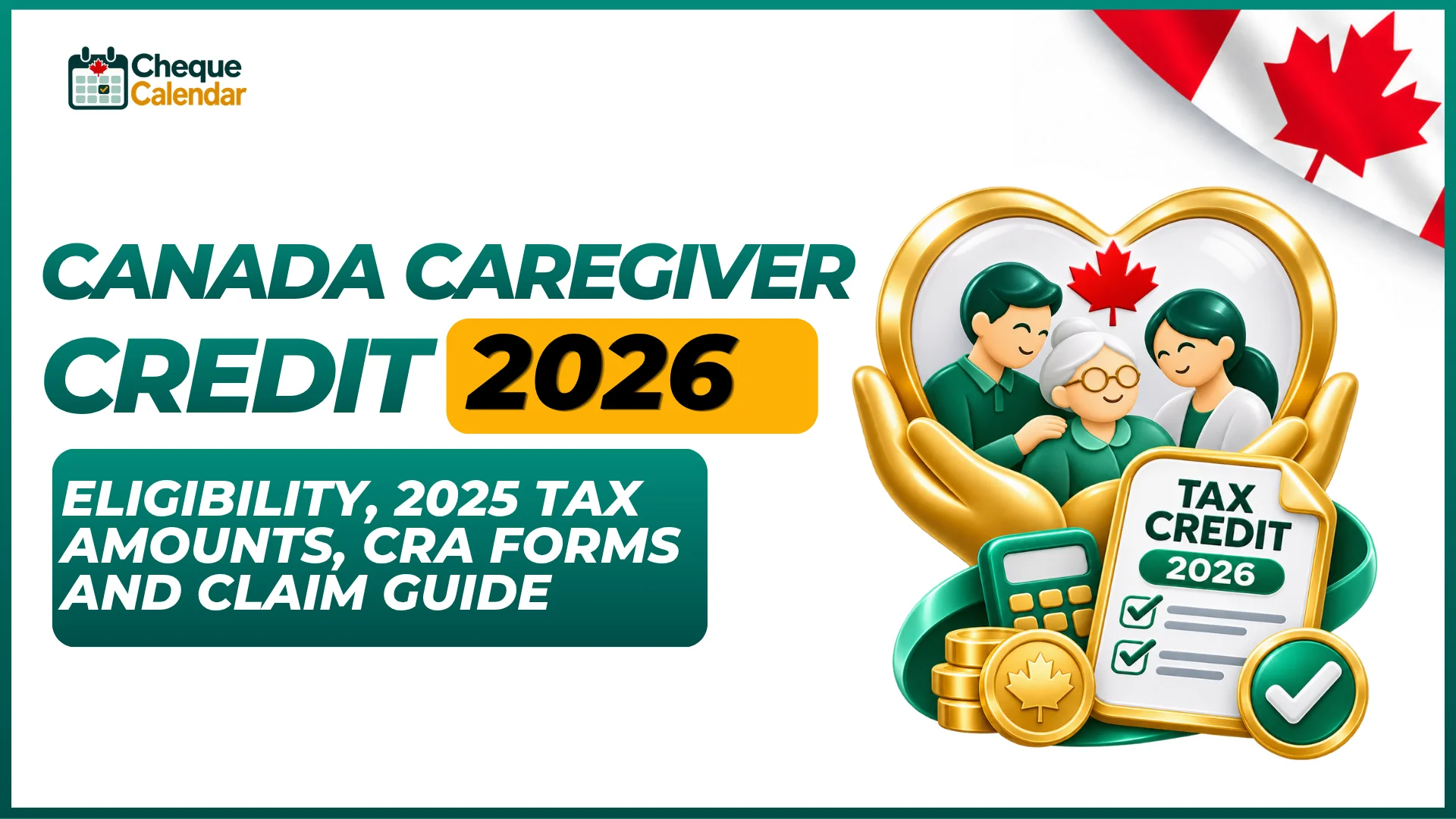
The Canada Caregiver Credit 2026 is a federal non-refundable tax credit that helps Canadians who support an eligible spouse, common-law partner or dependant with a mental or physical infirmity.
For the 2025 tax year, which most Canadians filed in 2026, the Canada Revenue Agency (CRA) identifies caregiver-related amounts of $2,687 and up to $8,601.
For the 2026 tax year, these amounts increase to $2,740 and up to $8,773, respectively, following annual inflation adjustments.
The amount you can claim depends on your relationship with the dependant, their net income, the support you provide and the applicable tax-return rules.
The Canada Caregiver Credit does not currently provide a separate monthly payment. Instead, it may reduce your federal income tax liability.
This Cheque Calendar guide explains caregiver eligibility, tax amounts, income thresholds, medical documentation, provincial tax provisions and the official CRA claiming process.
Canada Caregiver Credit 2026: Current Information Snapshot
The CRA uses different claim rules depending on whom you support and the nature of their dependency.
| Item | CRA Information |
|---|---|
| Type of credit | Federal non-refundable tax credit |
| Tax year covered | 2025 and 2026 |
| Qualifying condition | Dependency related to a mental or physical infirmity |
| 2025 specified caregiver amount | $2,687 |
| 2025 maximum adult caregiver amount | $8,601 |
| 2026 specified caregiver amount | $2,740 |
| 2026 maximum adult caregiver amount | $8,773 |
| Spouse or eligible adult dependant | Line 30425, with related claim lines |
| Other qualifying adult dependant | Line 30450 |
| Qualifying child under 18 | Line 30500 |
| Calculation form | Schedule 5, where applicable |
| Monthly payment schedule | None |
| Proposed refundable credit | Beginning in the 2027 tax year |
These figures represent tax-credit claim amounts rather than guaranteed government payments.
Official source: CRA — Canada Caregiver Credit.
Resource 1: Who Qualifies for the Canada Caregiver Credit 2026?
You may qualify for the Canada Caregiver Credit if you regularly support an eligible family member who depends on you because of a mental or physical infirmity.
However, the relationship, dependency, age, income and other circumstances must satisfy the applicable CRA requirements.
Eligible Family Relationships
Depending on the claim category, eligible family members may include:
- Your spouse or common-law partner.
- Your child or grandchild.
- Your parent or grandparent.
- Your brother or sister.
- Your aunt or uncle.
- Your niece or nephew.
- Eligible relatives of your spouse or common-law partner.
Being related to someone does not automatically make that person an eligible dependant.
What Does Dependent on You for Support Mean?
A dependant may qualify when they regularly rely on you to provide essential necessities, such as food, shelter and clothing.
For the Canada Caregiver Credit, the dependency must be connected to a mental or physical infirmity.
Occasionally helping a relative with expenses or household tasks does not automatically establish eligibility.
Does the Dependant Have to Live With You?
Not every caregiver claim has the same living-arrangement requirements.
For example, line 30400, the amount for an eligible dependant, has specific requirements concerning living arrangements and maintaining a home.
However, line 30450 for other qualifying adult infirm dependants does not impose the same general requirement that the dependant live with you.
Review the specific tax-return line before determining eligibility.
Do Certain Relatives Have to Have Lived in Canada?
Yes. For relevant caregiver claims, parents, grandparents, siblings, aunts, uncles, nieces and nephews generally must have been Canadian residents at some time during the tax year.
Different residence provisions apply to spouses, common-law partners, children and grandchildren.
The applicable relationship and dependency requirements must still be satisfied.
Resource 2: Canada Caregiver Credit Amounts for the 2025 Tax Year
The amount you can claim depends on your relationship with the dependant, their net income and the applicable CRA calculation.
| Claim Situation | Federal Line | 2025 Amount |
|---|---|---|
| Spouse or common-law partner with an infirmity | 30300 | $2,687 caregiver component |
| Additional qualifying spouse caregiver amount | 30425 | Up to $8,601, subject to calculation |
| Eligible adult dependant with an infirmity | 30400 | $2,687 caregiver component |
| Additional amount for an eligible adult dependant | 30425 | Up to $8,601, subject to calculation |
| Other qualifying infirm adult dependant | 30450 | Up to $8,601 |
| Qualifying infirm child under 18 | 30500 | $2,687 per child |
The amounts associated with lines 30300 and 30400 are caregiver components used within broader spouse or eligible-dependant calculations.
They are not the entire standard spouse or eligible-dependant tax credit.
Similarly, line 30425 provides a calculated additional amount. It should not be treated as an automatic second claim of $8,601.
Canada Caregiver Credit 2025 vs. 2026 Amounts
The amounts for the 2026 tax year are adjusted for inflation. Taxpayers preparing their 2026 returns, generally filed in 2027, should use the applicable 2026 amounts rather than the 2025 figures.
| Canada Caregiver Credit Amount | 2025 Tax Year | 2026 Tax Year |
|---|---|---|
| Specified caregiver amount | $2,687 | $2,740 |
| Maximum other adult dependant amount | $8,601 | $8,773 |
| Adult dependant income reduction threshold | $20,197 | $20,601 |
| Adult dependant income cut-off | $28,798 | $29,374 |
| Standard federal tax credit rate | 14.5% | 14% |
| Credit type | Non-refundable | Non-refundable |
| Return generally filed in | 2026 | 2027 |
The CRA’s annual indexation adjustment for 2026 is 2%. Canada
Official source: CRA — Indexation Adjustment for Personal Income Tax and Benefit Amounts.
Why the Maximum Claim Is Not the Same as Your Tax Savings
The Canada Caregiver Credit is non-refundable for the 2025 and 2026 tax years.
This means the eligible claim amount is used to calculate a reduction in federal income tax.
For example, an allowable caregiver amount of $8,601 does not mean the CRA will send you an $8,601 cheque.
The following examples illustrate the potential federal tax savings using the standard credit rate.
| Tax Year | Eligible Claim Amount | Standard Rate | Potential Tax Reduction |
|---|---|---|---|
| 2025 | $2,687 | 14.5% | $389.62 |
| 2025 | $8,601 | 14.5% | $1,247.15 |
| 2026 | $2,740 | 14% | $383.60 |
| 2026 | $8,773 | 14% | $1,228.22 |
These calculations are illustrative. Your actual tax savings depend on your federal tax liability, other credits and any applicable top-up tax credit provisions.
Canada Caregiver Credit 2027: Proposed Refundable Credit Under Budget 2026
Budget 2026 proposes a significant change to the Canada Caregiver Credit.
The federal government has proposed making the credit fully refundable beginning in the 2027 tax year.
Under the existing non-refundable system, caregivers with little or no federal income tax liability may receive limited or no financial benefit from the credit.
The proposed refundable credit would address this limitation.
Proposed Canada Caregiver Credit Amounts for 2027
| Proposed Provision | 2027 Amount |
|---|---|
| Maximum adult caregiver claim amount | $9,001 |
| Maximum associated tax relief | $1,260 |
| Qualifying child caregiver amount | $2,812 |
| Associated tax relief for a qualifying child | $394 |
| Adult dependant income reduction threshold | $21,136 |
| Proposed implementation | 2027 tax year onward |
The government estimates that approximately 585,000 caregivers would receive additional support, including 180,000 who currently receive no benefit from the existing credit. Budget 2026+1
Caregiver Tax Savings Calculator
Claim amount: $4,374
Income reduction: $4,399
Will Caregivers Receive $1,260 in 2026?
No. The proposed refundable Canada Caregiver Credit is intended to apply from the 2027 tax year.
It does not establish a guaranteed $1,260 payment in 2026.
The government has presented the measure as a proposal. Implementation remains subject to the applicable legislative process and final CRA instructions.
For 2025 and 2026 claims, taxpayers should continue following the existing non-refundable credit rules.
Official sources: Budget 2026 — A More Affordable Life and Budget 2026 — Tax Measures.
Resource 3: Canada Caregiver Credit for a Spouse or Common-Law Partner
If you support a spouse or common-law partner with a qualifying mental or physical infirmity, you may be eligible for caregiver-related tax amounts.
The CRA identifies line 30300 for the spouse or common-law partner amount.
An additional caregiver amount may also be available on line 30425.
What Is Line 30300?
Line 30300 is the spouse or common-law partner amount.
Where the spouse has a qualifying infirmity, the relevant calculation may include a caregiver component.
This component is $2,687 for 2025 and $2,740 for 2026.
It is not the entire standard spouse or common-law partner amount.
What Is Line 30425?
Line 30425 applies to qualifying spouses, common-law partners and eligible adult dependants who meet the related claiming requirements.
For the 2025 tax year, the caregiver calculation uses a maximum amount of $8,601.
The corresponding indexed maximum for 2026 is $8,773.
However, the actual additional amount must be calculated using Schedule 5 and depends on the dependant’s net income and related spouse or eligible-dependant amounts.
Can Two People Split the Same Line 30425 Claim?
No. Line 30425 cannot be divided between multiple claimants.
Only one eligible person can claim the applicable amount for the dependant.
Official source: CRA — Line 30425 Caregiver Amount.
Resource 4: Canada Caregiver Credit for Other Adult Dependants
Line 30450 is available for other qualifying infirm dependants aged 18 or older.
This may include a parent, grandparent, adult child, sibling, aunt, uncle, niece or nephew who depends on you because of a qualifying infirmity.
What Is the Maximum Amount on Line 30450?
The maximum amount for each qualifying adult dependant is:
| Tax Year | Maximum Claim | Dependant Net Income Cut-Off |
|---|---|---|
| 2025 | $8,601 | $28,798 |
| 2026 | $8,773 | $29,374 |
The allowable amount decreases when the dependant’s net income exceeds the applicable income reduction threshold.
Can You Claim for More Than One Adult Dependant?
Yes. Separate claims may be available for multiple qualifying adult dependants.
Each dependant must independently meet the relevant relationship, age, dependency, residency and income requirements.
Can Caregivers Share a Line 30450 Claim?
Yes, in certain circumstances.
If multiple eligible individuals supported the same dependant during the year, they may divide the allowable claim.
However, their combined claim cannot exceed the amount permitted for that dependant.
This differs from line 30425, which cannot be split.
When Can You Not Claim Line 30450?
You generally cannot claim this amount if:
- The dependant does not have a qualifying mental or physical infirmity.
- Another person claims the same dependant on line 30300 or 30400.
- The dependant does not satisfy the applicable income or residency requirements.
- You were required to pay child support for the dependant, subject to specific exceptions.
Special rules may apply following separation or the breakdown of a relationship.
Is a Temporary Injury Enough?
No. A temporary illness or injury does not meet the CRA’s infirmity requirement for this caregiver amount.
The dependency must arise from an infirmity that requires support over a considerable period.
Supporting an elderly parent does not automatically establish eligibility if the parent does not have a qualifying infirmity.
Official source: CRA — Line 30450 for Other Infirm Adult Dependants.
Resource 5: Canada Caregiver Credit for Children Under 18
The CRA provides a separate caregiver amount for qualifying children under 18.
The amount is generally claimed on line 30500.
| Tax Year | Amount per Qualifying Child |
|---|---|
| 2025 | $2,687 |
| 2026 | $2,740 |
| 2027 proposed refundable system | $2,812 claim amount, providing up to $394 in tax relief |
Which Children May Qualify?
Depending on the circumstances, the definition may include:
- Your biological or adopted child.
- Your spouse’s or common-law partner’s biological or adopted child.
- Your child’s spouse or common-law partner.
- A child under your custody and control who is completely dependent on you for support.
The child must have a qualifying mental or physical infirmity and require substantially more assistance with personal needs and care than other children of the same age.
The dependency must be expected to continue over a long and continuous period of indefinite duration.
Does the Child Have to Be Under 18 at Year-End?
Generally, yes.
For a 2025 claim, the child must normally have been under 18 at the end of 2025.
The CRA also permits the full eligible amount in the year of the child’s birth, death or adoption.
Is There an Income Test for Children Under 18?
There is no separate dependant income test for the qualifying child caregiver amount under line 30500.
However, other conditions concerning the child’s infirmity, care requirements, custody and support payments must still be satisfied.
Do Shared-Custody Rules Apply?
Yes. Where parents share custody, the person claiming the eligible-dependant amount may be entitled to claim the caregiver amount.
If the parents cannot agree on who should claim it under the applicable shared-custody rules, neither may qualify to claim that amount.
Child support payments can also affect eligibility.
Only one line 30500 claim can be made per child. The same caregiver component should not be duplicated through line 30400.
Is Schedule 5 Needed for Line 30500?
No. Schedule 5 is not required specifically for claiming the caregiver amount on line 30500.
Other claims on your tax return may still require Schedule 5.
In certain circumstances, unused amounts for qualifying children may also be transferred between spouses or common-law partners through line 32600.
Official source: CRA — Line 30500, Infirm Children Under 18.
Resource 6: How the Dependant’s Income Affects the Claim
The dependant’s net income affects several caregiver-related calculations.
However, the same income thresholds do not apply universally to every caregiver claim.
Important Canada Caregiver Credit Income Thresholds
| Income Rule | 2025 | 2026 |
|---|---|---|
| Maximum line 30450 caregiver amount | $8,601 | $8,773 |
| Income threshold before reduction | $20,197 | $20,601 |
| Adult dependant income cut-off | $28,798 | $29,374 |
For line 30425, the CRA’s 2025 guidance identifies a dependant net income range of $8,624 to $28,798.
The actual amount must be calculated through Schedule 5.
How to Calculate the Caregiver Amount for Other Adult Dependants
For the standard 2025 line 30450 calculation, the maximum $8,601 amount decreases dollar-for-dollar when the dependant’s net income exceeds $20,197.
2025 claim formula:
Maximum caregiver amount of $8,601 minus any dependant net income exceeding $20,197.
2026 claim formula:
Maximum caregiver amount of $8,773 minus any dependant net income exceeding $20,601.
The result cannot be less than zero.
Illustrative Canada Caregiver Credit Calculations
| Adult Dependant Net Income | 2025 Claim Amount | 2026 Claim Amount |
|---|---|---|
| $15,000 | $8,601 | $8,773 |
| $20,000 | $8,601 | $8,773 |
| $22,000 | $6,798 | $7,374 |
| $25,000 | $3,798 | $4,374 |
| $28,000 | $798 | $1,374 |
| $29,000 | $0 | $374 |
| $30,000 | $0 | $0 |
These calculations assume all other eligibility conditions are met.
They represent claim amounts, not the actual cash refund or tax reduction.
The formula applies to the standard other-adult-dependant calculation rather than every Canada Caregiver Credit category.
Resource 7: Medical Documents and Supporting Evidence
You generally do not need to submit supporting medical documents with your original tax return unless requested.
However, the CRA may review your claim and request evidence later.
What Medical Statement May the CRA Request?
The CRA may require a signed statement from a medical practitioner explaining:
- When the mental or physical infirmity began.
- How long the infirmity is expected to continue.
Additional information may be required when the claim relates to a child under 18.
What Must a Medical Statement Say for a Child?
The statement should establish that the child needs considerably more assistance than other children of the same age and that the dependency resulting from the infirmity is expected to continue for an indefinite period.
Do You Need Form T2201?
Not necessarily.
Where the CRA already has an approved Form T2201, Disability Tax Credit Certificate, covering the relevant period, a separate medical statement is not required.
However, the Disability Tax Credit and Canada Caregiver Credit are separate tax provisions.
Disability Tax Credit approval is not a universal prerequisite for claiming the Canada Caregiver Credit.
What Records Should You Keep?
Useful supporting documents may include:
- Information establishing the family relationship.
- Records of the financial or practical support provided.
- The dependant’s income information.
- Medical statements, where required.
- Approved Disability Tax Credit documentation.
- Relevant CRA correspondence.
Generally, tax records should be retained for at least six years, subject to applicable CRA record-keeping requirements.
Official sources:
CRA — Form T2201, Disability Tax Credit Certificate
CRA — Disability-Related Information
Resource 8: How to Claim the Canada Caregiver Credit
The Canada Caregiver Credit is claimed through your federal income tax and benefit return.
There is no separate monthly caregiver payment application under the existing credit.
Step 1: Identify the Correct Claim Category
Determine whether you supported a spouse, common-law partner, eligible adult dependant, another qualifying adult dependant or a qualifying child under 18.
The correct federal tax line depends on your relationship and circumstances.
Step 2: Review the Dependant’s Net Income
Where required, obtain the dependant’s net income from line 23600 of their income tax return.
If the dependant did not file a return, an appropriate estimate may be used where permitted by the CRA.
Step 3: Complete Schedule 5 Where Required
Use Schedule 5, Amounts for Spouse or Common-Law Partner and Dependants, to calculate applicable spouse and adult-dependant amounts.
Schedule 5 is not specifically required for the line 30500 caregiver amount for infirm children under 18.
Step 4: Enter the Amount on the Appropriate Tax Line
| Federal Tax Line | Purpose |
|---|---|
| 30300 | Spouse or common-law partner amount |
| 30400 | Amount for an eligible dependant |
| 30425 | Additional caregiver amount for a spouse or eligible adult dependant |
| 30450 | Caregiver amount for other qualifying infirm adult dependants |
| 30500 | Caregiver amount for qualifying infirm children under 18 |
You do not need to complete every line. Use only those that apply to your circumstances.
Which CRA Tax Line Should You Use?
Select your relationship with the dependant.
Use Schedule 5 to calculate the applicable spouse and caregiver amounts.
Check the eligible-dependant requirements and complete Schedule 5 where applicable.
Maximum 2026 claim: $8,773, subject to income and eligibility requirements.
2026 amount: $2,740 per qualifying child. Schedule 5 is not specifically required for this line.
Step 5: File Your Tax Return and Keep Supporting Records
Complete and submit your income tax return using an applicable CRA filing method.
Keep the documents supporting your claim in case the CRA requests them during a review.
Important Tax Filing Deadlines
| Filing Requirement | 2025 Tax Return | 2026 Tax Return |
|---|---|---|
| Most individual tax returns | April 30, 2026 | April 30, 2027 |
| Most self-employed tax returns | June 15, 2026 | June 15, 2027 |
| General deadline for paying tax owing | April 30, 2026 | April 30, 2027 |
Special filing circumstances may have different deadlines.
If you have not filed your 2025 tax return, you can still submit it and claim eligible caregiver amounts. Late-filing penalties and interest may apply.
Official form: CRA — Schedule 5, Amounts for Spouse or Common-Law Partner and Dependants.
Resource 9: Federal and Provincial Caregiver Tax Credits
The Canada Caregiver Credit is a federal tax credit.
However, certain provinces and territories also provide separate caregiver-related tax amounts.
Provincial and Territorial Caregiver Credit Examples
| Province or Territory | Relevant Tax Provision |
|---|---|
| Ontario | Ontario caregiver amount, line 58185 |
| British Columbia | British Columbia caregiver amount, line 58175 |
| Quebec | Separate caregiver tax credit through Revenu Québec |
| Yukon | Yukon caregiver amount and specific provision for qualifying infirm children |
| Other provinces and territories | Applicable provincial or territorial tax provisions |
Provincial tax-credit amounts, eligibility rules and calculations may differ from the federal Canada Caregiver Credit.
How Provincial or Territorial Claims Work
Residents outside Quebec generally use the appropriate provincial or territorial Form 428 when calculating applicable provincial caregiver amounts.
For example, Ontario residents can review Form ON428, while British Columbia residents can review Form BC428.
Yukon provides a corresponding caregiver amount for qualifying infirm children under 18 through line 58189 of Form YT428.
What About Quebec?
Quebec has a separate provincial income tax system administered by Revenu Québec.
Eligible caregivers may qualify for a separate Quebec caregiver tax credit under its own eligibility requirements.
However, the federal Canada Caregiver Credit remains a separate federal claim.
Do not assume that the federal caregiver amounts also apply to provincial claims.
Official source: Revenu Québec.
Resource 10: What Happens After You Claim the Credit?
The CRA assesses your caregiver claim as part of your income tax return.
You do not receive a separate CCC approval letter establishing a monthly payment schedule.
How to Check Your Assessed Claim
Sign in to CRA My Account and review your assessed income tax return and notice of assessment.
Check whether the applicable caregiver amount has been accepted or adjusted.
If the CRA changes your claim, review the relevant correspondence for further instructions.
What If the CRA Requests Supporting Documents?
Respond using the official instructions provided by the CRA.
Depending on the claim, the agency may request medical statements, income information or documents supporting the dependant relationship.
Never send sensitive medical or financial documents through unfamiliar websites or unverified email addresses.
Does the Canada Caregiver Credit Have a Payment Date?
No. For the 2025 and 2026 tax years, the Canada Caregiver Credit is non-refundable and is processed through the income tax assessment system.
There is no separate monthly Canada Caregiver Credit payment schedule.
The proposed refundable credit for 2027 should not be interpreted as an announced monthly benefit payment.
What If You Forgot to Claim the Canada Caregiver Credit?
If your original tax return has already been assessed, you may request an adjustment using:
- Change My Return through your CRA account.
- ReFILE through eligible tax software.
- Form T1-ADJ, where applicable.
The CRA generally permits adjustments for tax years ending within the previous 10 calendar years, subject to applicable restrictions.
Do not submit a duplicate original tax return for the same year. If your tax assessment results in a refund, check our CRA Direct Deposit 2026 guide to ensure your banking information is up to date.
Official sources:
CRA — How to Change Your Tax Return
Canada Caregiver Credit: Key Terms and Definitions
| Term | Meaning |
|---|---|
| Non-refundable tax credit | Reduces applicable income tax liability without independently creating a payment beyond that liability |
| Refundable tax credit | May provide a financial benefit even when the claimant has little or no tax liability |
| Dependant | An eligible individual who relies on another person for support |
| Mental or physical infirmity | An impairment that creates the dependency required under the relevant caregiver rules |
| Schedule 5 | Federal form used to calculate applicable spouse and dependant amounts |
| Form T2201 | Disability Tax Credit Certificate |
| Net income | Relevant income amount used to determine applicable tax-credit eligibility and reductions |
| Income reduction threshold | Income level above which the applicable caregiver amount begins to decrease |
Frequently Asked Questions About the Canada Caregiver Credit
1. What Is the Canada Caregiver Credit in 2026?
The Canada Caregiver Credit is a federal non-refundable tax credit for eligible individuals supporting family members with a mental or physical infirmity.
For 2025 returns filed in 2026, the relevant amounts include $2,687 and up to $8,601.
For the 2026 tax year, these amounts increase to $2,740 and up to $8,773.
2. Who Is Eligible to Claim the Canada Caregiver Credit?
You may qualify if you support an eligible spouse, common-law partner or dependant who relies on you because of a qualifying infirmity.
Relationship, income, age, residency and dependency requirements vary according to the applicable claim category.
3. How Much Is the Canada Caregiver Credit for the 2025 Tax Year?
The CRA identifies caregiver-related amounts of $2,687 and up to $8,601 for 2025.
The actual claim depends on your circumstances and the dependant’s income.
These are claim amounts rather than guaranteed cash payments.
4. Can I Claim the Canada Caregiver Credit for My Parent?
Yes, if your parent meets the applicable requirements.
Your parent must depend on you because of a qualifying infirmity and satisfy the relevant income and residency conditions.
Supporting an elderly parent does not automatically establish eligibility.
5. Can I Claim the Credit for My Spouse or Common-Law Partner?
Yes. Caregiver-related amounts may be available through lines 30300 and 30425.
The actual amount depends on the relevant Schedule 5 calculation.
A line 30425 claim cannot be divided between multiple claimants.
6. Can I Claim the Canada Caregiver Credit for a Child Under 18?
Yes. The federal amount is $2,687 per qualifying child for 2025 and $2,740 for 2026.
The child must have a qualifying infirmity that creates substantial and ongoing additional care needs.
Shared-custody and child-support restrictions may also apply.
7. Do I Need to Submit Medical Documents With My Tax Return?
Generally, no.
However, retain medical statements and other supporting records because the CRA may request them later.
An approved Form T2201 covering the relevant period may eliminate the need for a separate medical statement.
8. Do I Need the Disability Tax Credit to Claim CCC?
Not necessarily. The Disability Tax Credit and Canada Caregiver Credit have different eligibility rules.
An appropriate medical statement may support a caregiver claim even when the dependant does not have an approved Disability Tax Credit Certificate.
9. What Is the Difference Between Lines 30425 and 30450?
Line 30425 concerns a qualifying spouse, common-law partner or eligible adult dependant.
Line 30450 applies to other qualifying infirm adult dependants.
Line 30425 cannot be split, while line 30450 may be shared between eligible supporters within the allowable limit.
10. Can Two Family Members Claim for the Same Dependant?
It depends on the claim category.
Eligible supporters may divide a line 30450 claim, provided their combined amount does not exceed the allowable maximum.
Other caregiver claim categories have different restrictions.
11. Does Shared Custody Affect the Canada Caregiver Credit?
Yes. Shared custody and child support can determine which parent may claim the caregiver amount.
Where agreement is required and the parents cannot agree, neither may be entitled to claim the amount.
Only one line 30500 claim is permitted per qualifying child.
12. Can I Claim the Canada Caregiver Credit if the Dependant Has Income?
Possibly. For the standard line 30450 calculation, the dependant’s net income must be below $28,798 for 2025 or $29,374 for 2026.
The qualifying child caregiver amount has no separate dependant income test.
Different calculations apply to other claim categories.
13. Is the Canada Caregiver Credit Refundable?
The credit remains non-refundable for the 2025 and 2026 tax years.
Budget 2026 proposes making it fully refundable beginning in 2027, potentially providing eligible caregivers with up to $1,260 annually.
The proposed change is subject to implementation and should not be treated as an existing 2026 payment.
14. Does the Canada Caregiver Credit Have Monthly Payment Dates?
No. The existing credit is claimed through the income tax return.
There is no separate monthly CCC payment schedule for 2026.
The CRA assesses the caregiver amount as part of your overall tax calculation.
15. Can I Claim the Canada Caregiver Credit for More Than One Dependant?
Yes, where each dependant satisfies the relevant conditions.
Separate claims may be available for multiple qualifying adult dependants and qualifying children under 18.
Claim-sharing and other eligibility restrictions still apply.
16. Can I Claim a Provincial Caregiver Credit as Well?
Possibly. Certain provinces and territories provide separate caregiver-related tax credits.
Their amounts and eligibility requirements may differ from the federal credit.
Check the appropriate provincial or territorial tax form or Revenu Québec guidance.
17. What If I Forgot to Claim the Canada Caregiver Credit?
If your original return has already been assessed, you may request an adjustment through Change My Return, eligible ReFILE software or the applicable paper adjustment procedure.
You must still satisfy the original tax year’s eligibility requirements.
18. Where Can I Check My Canada Caregiver Credit Claim?
Sign in to your CRA account and review your assessed tax return and notice of assessment.
Use Schedule 5 and the relevant CRA claim instructions to understand your calculated amount.
If the CRA adjusts or rejects your claim, review its correspondence or contact the agency through its official channels.
Official Government Resource Directory
Canada Revenue Agency — Canada Caregiver Credit Overview
CRA — Line 30425: Spouse, Common-Law Partner or Eligible Adult Dependant
CRA — Line 30450: Other Infirm Adult Dependants
CRA — Line 30500: Infirm Children Under 18
CRA — Line 30300: Spouse or Common-Law Partner Amount
CRA — Line 30400: Amount for an Eligible Dependant
CRA — Schedule 5: Amounts for Spouse or Common-Law Partner and Dependants
CRA — Guide RC4064, Disability-Related Information
CRA — Form T2201, Disability Tax Credit Certificate
CRA — Indexation Adjustment for Personal Income Tax and Benefit Amounts
CRA — Family, Child Care and Caregiver Tax Credits
Department of Finance Canada — Budget 2026 Tax Measures
Department of Finance Canada — Budget 2026: A More Affordable Life
CRA — Change Your Income Tax Return
Revenu Québec — Provincial Tax Information
Final Reference: What to Remember About the Canada Caregiver Credit
The Canada Caregiver Credit 2026 provides federal tax relief to eligible Canadians who support family members with a mental or physical infirmity.
For the 2025 tax year, the specified caregiver amounts are $2,687 and up to $8,601. For the 2026 tax year, the indexed amounts increase to $2,740 and up to $8,773.
These are tax-credit claim amounts rather than guaranteed government payments.
Budget 2026 proposes making the Canada Caregiver Credit fully refundable beginning in the 2027 tax year, potentially providing eligible caregivers with up to $1,260 annually. This remains a proposed future measure and does not establish a new caregiver payment for 2026.
Before claiming the credit, identify the correct tax-return line, confirm the dependant’s eligibility, review their net income and retain the necessary supporting medical documents.
If you forgot to claim an eligible caregiver amount on a previously assessed return, you may be able to request an adjustment through the CRA.
Always consult the official CRA guidance for the relevant tax year before filing your claim.
Cheque Calendar is an independent informational website and is not affiliated with the Government of Canada or the Canada Revenue Agency. This article provides general information and does not constitute financial, legal or tax advice.
Individual eligibility and tax savings may vary. Proposed legislative changes, including the refundable Canada Caregiver Credit for 2027, remain subject to implementation. Always confirm your entitlement through official CRA guidance, your CRA account and your notice of assessment or reassessment.
2 thoughts on “Canada Caregiver Credit 2026: Eligibility, 2025 Tax Amounts, CRA Forms and Claim Guide”
Comments are closed.