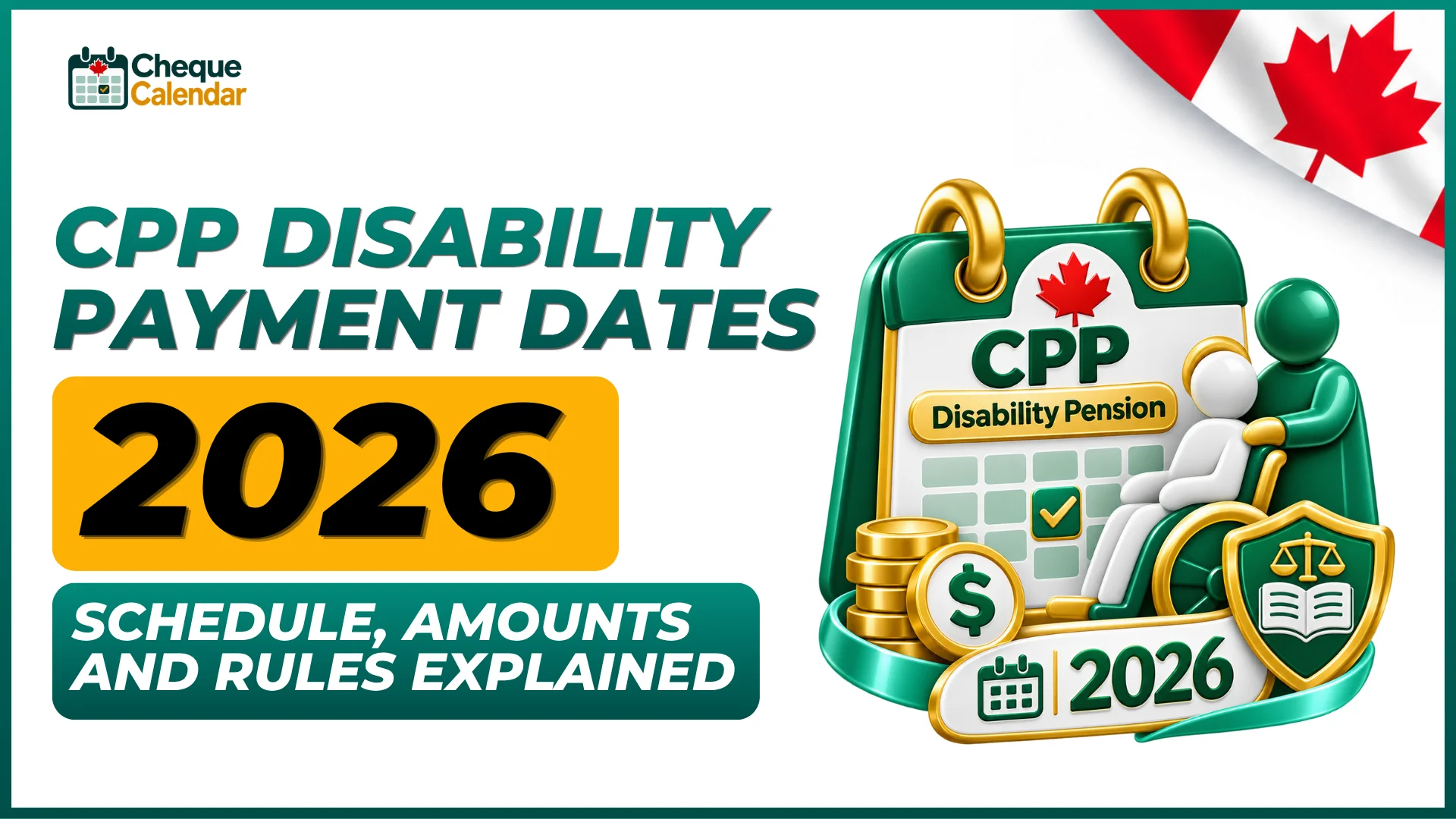
The next CPP disability payment date in 2026 is Thursday, November 26, followed by Tuesday, December 22, 2026. These are the remaining scheduled Canada Pension Plan (CPP) disability payment dates for the year.
The published maximum monthly CPP disability benefit for January 2026 is $1,741.20, increasing to $1,754.05 for December 2026 under the applicable CPP enhancement calculations.
However, knowing when the money arrives is only part of understanding CPP disability benefits. Recipients also need to understand how monthly payments are calculated, which activities must be reported, when benefits may stop and how Service Canada reviews eligibility.
The Canada Pension Plan disability benefit provides monthly income support to eligible contributors who cannot work regularly because of a severe and prolonged disability.
It operates under federal CPP rules, which are separate from provincial disability assistance programs and the Canada Disability Benefit.
This Cheque Calendar guide explains payment schedules, benefit amounts, eligibility requirements, earnings thresholds, reporting responsibilities and other important CPP disability rules.
The CPP Disability Payment Rule That Matters Most
Approved CPP disability benefits follow the monthly Canada Pension Plan payment calendar.
The same calendar applies to CPP retirement pensions, disability benefits, survivor benefits and eligible children’s benefits.
The remaining scheduled payments for 2026 are:
- Thursday, November 26, 2026
- Tuesday, December 22, 2026
Service Canada distributes benefits through direct deposit or cheque. However, the scheduled payment date does not guarantee that every recipient will receive their money at the same time.
Direct deposits generally arrive more quickly, while mailed cheques may take longer.
The Government of Canada recommends waiting 5 to 10 business days before contacting the responsible program about a missing payment.
Official source: Government of Canada — Benefits Payment Dates.
CPP Disability Payment Dates 2026: Complete Official Schedule
The following table shows the official CPP disability payment schedule for January through December 2026.
| Payment Month | Scheduled Payment Date | Status as of November 23 |
|---|---|---|
| January | January 28, 2026 | Passed |
| February | February 25, 2026 | Passed |
| March | March 27, 2026 | Passed |
| April | April 28, 2026 | Passed |
| May | May 27, 2026 | Passed |
| June | June 26, 2026 | Passed |
| July | July 29, 2026 | Passed |
| August | August 27, 2026 | Passed |
| September | September 25, 2026 | Passed |
| October | October 28, 2026 | Passed |
| November | November 26, 2026 | Next scheduled payment |
| December | December 22, 2026 | Final payment of 2026 |
All dates follow the official Government of Canada CPP payment calendar.
Why Does the December Payment Arrive Earlier?
CPP disability payments do not arrive on the same numerical date every month.
The December 2026 payment is scheduled for December 22, earlier than the November payment date.
This does not represent an additional monthly benefit, Christmas bonus or special double payment.
Recipients should follow the published government calendar rather than assume that payments always arrive on the final business day of each month.
Are the 2027 CPP Disability Payment Dates Available?
Yes. The Government of Canada has published the complete CPP payment schedule for 2027.
| Payment Month | Official 2027 Payment Date |
|---|---|
| January | January 27, 2027 |
| February | February 24, 2027 |
| March | March 25, 2027 |
| April | April 28, 2027 |
| May | May 27, 2027 |
| June | June 28, 2027 |
| July | July 28, 2027 |
| August | August 27, 2027 |
| September | September 27, 2027 |
| October | October 27, 2027 |
| November | November 26, 2027 |
| December | December 22, 2027 |
These dates apply to CPP disability payments as well as the other benefits covered by the CPP calendar.
Official sources:
Government of Canada — Benefits Payment Dates
Service Canada — Receiving Your CPP Disability Benefits
What the CPP Disability Benefit Covers
CPP disability is a federal contributory benefit designed to provide income support to eligible individuals whose disabilities prevent them from working regularly.
Eligibility depends partly on a person’s CPP contribution record, together with the applicable age and disability requirements.
CPP disability is not the same as provincial disability assistance. It also does not automatically provide coverage for medication, medical equipment or other health-care expenses.
Other federal, provincial or territorial programs may provide additional support depending on individual circumstances.
CPP Disability Versus the Canada Disability Benefit
The Canada Disability Benefit (CDB) is a separate federal program with its own eligibility requirements and payment schedule.
| Payment Month | CPP Disability | Canada Disability Benefit |
|---|---|---|
| November 2026 | November 26 | November 19 |
| December 2026 | December 22 | December 17 |
Receiving CPP disability does not automatically establish eligibility for the Canada Disability Benefit.
Each program has separate qualifying conditions, application procedures and payment calculations.
Official source: Canada Disability Benefit — Payments.
Can You Receive CPP Disability Alongside Other Disability Income?
You may still qualify for CPP disability if you receive disability income from a private insurance company or a provincial or territorial assistance program.
However, the other provider may reduce its payments after your CPP disability benefit is approved.
For example, some long-term disability insurance policies deduct CPP disability payments from the amount they provide.
Contact your insurance provider or provincial assistance program to understand how CPP disability may affect your existing financial support.
Important CPP Disability Eligibility Conditions
The Government of Canada assesses CPP disability eligibility using three main requirements:
- Age.
- Severe and prolonged disability.
- Sufficient CPP contributions.
Meeting only one of these requirements does not establish eligibility.
Age Requirements
Regular CPP disability benefits generally apply to eligible people aged 18 or older and under 65.
Special provisions may apply to people who recently turned 65 or are already receiving CPP retirement benefits.
Service Canada encourages people who recently turned 65 to apply if they believe they may qualify for retroactive disability payments.
Severe and Prolonged Disability
A qualifying disability must be both severe and prolonged under CPP legislation.
A severe disability regularly prevents a person from performing substantially gainful work.
A prolonged disability is long-term and of indefinite duration or is likely to result in death.
A medical diagnosis alone does not establish eligibility. Service Canada considers how the condition affects the applicant’s ability to work regularly, alongside medical documentation and other relevant information.
CPP Contribution Requirements
Applicants must also have sufficient CPP contributions.
Service Canada generally examines the six years before the disability prevented the applicant from working.
Under the standard contribution requirements, applicants must generally have contributed:
- In four of the previous six years; or
- In three of the previous six years, with at least 25 years of CPP contributions overall.
Other provisions may help applicants who do not meet these standard conditions.
What If You Do Not Have Enough CPP Contributions?
You may still qualify under special provisions involving:
- International social security agreements.
- Child-rearing periods.
- CPP credit splitting following divorce or separation.
- Late-applicant provisions.
You can review your CPP Statement of Contributions through My Service Canada Account.
Service Canada determines whether the relevant contribution conditions have been satisfied.
What About Quebec Pension Plan Disability Benefits?
Quebec operates the Quebec Pension Plan (QPP), which provides separate disability benefits.
Depending on your residence and employment history, you may need to apply through Retraite Québec rather than the Canada Pension Plan.
This may apply if you worked exclusively in Quebec, currently live in Quebec and contributed to the QPP, or live abroad and last resided in Quebec.
Contributions made under both pension plans may be considered under the applicable coordination rules.
Official sources:
CPP Disability — Do You Qualify?
How Much Is the CPP Disability Benefit in 2026?
The Government of Canada publishes maximum and average CPP disability benefit amounts.
For January 2026, the published maximum monthly CPP disability benefit is $1,741.20.
The government also reports an average monthly payment of $1,236.32 for new CPP disability beneficiaries in July 2026.
However, CPP enhancement causes the maximum benefit for newly starting pensions to increase during the year.
CPP Disability Benefit Amounts 2026
| Benefit Information | Monthly Amount |
|---|---|
| Basic CPP disability component | $610.46 |
| Maximum regular CPP disability benefit, January 2026 | $1,741.20 |
| Average payment for new beneficiaries, July 2026 | $1,236.32 |
| Maximum regular CPP disability benefit, December 2026 | $1,754.05 |
| CPP post-retirement disability benefit | $610.46 |
| Disabled contributor’s children’s benefit, under 18 | $307.81 |
| Children’s benefit, eligible full-time student | $307.81 |
| Children’s benefit, eligible part-time student | $153.91 |
| Maximum combined survivor’s and disability benefit, January 2026 | $1,756.14 |
The published average payment is not a guaranteed individual entitlement.
The maximum amounts depend on the applicable benefit calculation and starting period.
Official sources:
CPP Disability Benefit Toolkit
Why Are There Different Maximum Amounts During 2026?
CPP enhancement has gradually increased contribution-related benefit amounts since 2019.
As a result, maximum amounts for new CPP disability benefits increase during 2026.
| Reference Period | Maximum Monthly CPP Disability |
|---|---|
| January 2026 | $1,741.20 |
| December 2026 | $1,754.05 |
| Difference | $12.85 |
This difference does not mean every existing CPP disability recipient automatically receives an additional $12.85 in December.
The figures describe the changing maximum amounts under CPP enhancement.
Existing benefits are also reviewed annually in January to reflect applicable increases in the cost of living. Benefits do not decrease when the cost of living falls.
How Does Service Canada Calculate an Individual Payment?
The regular CPP disability benefit contains two main components:
| Component | Explanation |
|---|---|
| Basic monthly amount | $610.46 in 2026 |
| Contribution-related amount | Calculated using the recipient’s CPP contribution history |
The two components determine the total monthly CPP disability pension.
For example, two individuals with similar medical conditions may receive different monthly payments because their CPP contribution histories differ.
The approved payment amount is provided in the recipient’s Service Canada decision letter.
Official source: CPP Disability — How Much You Could Receive.
When Do CPP Disability Benefits Begin?
The date a person becomes entitled to CPP disability and the date they receive their first actual payment are not necessarily the same.
Under the general rule, CPP disability benefits begin four months after the date the disability is determined to have become severe and prolonged.
For example:
| Established Disability Month | Illustrative Benefit Start Month |
|---|---|
| January | May |
| March | July |
| July | November |
| August | December |
| September | January of the following year |
These examples illustrate the general entitlement rule. They do not predict when Service Canada will approve a specific application or issue its first deposit.
Can Recipients Receive Retroactive CPP Disability Payments?
Yes. Qualifying applicants may receive up to 11 months of retroactive disability payments before the date their application was received.
However, approval does not automatically mean every applicant receives 11 months of back payments.
The amount depends on the established disability date, application date and applicable program rules.
Service Canada’s decision letter confirms the first payment date and amount.
How Long Does a CPP Disability Application Take?
Service Canada publishes the following application processing targets.
| Application Category | Processing Target |
|---|---|
| Regular CPP disability application | 120 calendar days |
| Eligible applicant with a grave condition | 30 calendar days |
| Eligible applicant with a terminal illness | 5 business days |
Priority processing is available only to applicants who meet the relevant conditions.
Processing may take longer if documents are missing or Service Canada needs additional medical information.
These are processing targets, not guaranteed approval or payment dates.
What If Your CPP Disability Application Is Denied?
If you disagree with Service Canada’s decision, you generally have 90 days from receiving your decision letter to request reconsideration.
You may request reconsideration using the applicable online service, Form ISP-1145 or a written request.
If you disagree with the reconsideration decision, you may be able to appeal to the Social Security Tribunal of Canada.
Review the decision letter and official instructions carefully to avoid missing applicable deadlines.
Official sources:
CPP Disability — After You Apply
Social Security Tribunal of Canada
How CPP Disability Payments Are Delivered
Service Canada distributes CPP disability benefits through direct deposit or cheque.
Your payment method does not change your entitlement, although it can affect how quickly you receive your money.
Direct Deposit
Direct deposit sends your monthly CPP disability payments directly into your registered bank account.
Service Canada recommends direct deposit because it reduces dependence on postal delivery.
As of November 23, 2026, CPP recipients cannot update their banking information through the normal My Service Canada Account personal-information update service.
Instead, recipients can:
- Contact the CPP telephone service.
- Request a Service Canada callback.
- Visit a Service Canada office.
Changing your banking information through CRA My Account does not automatically update your CPP disability payment account.
If you switch banks, keep your previous account open until you confirm that your payments are reaching the new account.
Official source: Service Canada — Change Your Personal Information.
Payment by Cheque
Service Canada states that CPP disability cheques are mailed during the last three business days of each month.
However, the mailing date is not necessarily the delivery date.
Postal delays may affect when the cheque arrives. Recipients should distinguish the scheduled direct deposit payment date from the actual delivery of a mailed cheque.
CPP Disability Work and Earnings Rules for 2026
CPP disability recipients may be able to attempt a return to employment without immediately losing their benefits.
However, work activity can affect continuing eligibility if it demonstrates that the recipient is capable of working regularly.
For 2026, the government identifies an annual earnings reporting threshold of $7,400 before tax and a substantially gainful earnings amount of $20,971.45.
CPP Disability Earnings Thresholds 2026
| Annual Gross Earnings | Potential Impact |
|---|---|
| Below $7,400 | Earnings alone should not affect disability benefits |
| $7,400 to below $20,971.45 | Service Canada may review work capacity and continued eligibility |
| $20,971.45 or more | Recipient will likely no longer qualify, subject to assessment |
These thresholds refer to gross earnings before tax.
According to the detailed CPP disability toolkit, recipients should contact Service Canada when they begin working and again when their earnings reach $7,400 during 2026.
CPP Disability Earnings Monitor 2026
$7,400+: contact Service Canada.
$20,971.45+: eligibility may be affected.
Report your return to work regardless of earnings. This tool does not determine eligibility.
Does Earning $7,400 Automatically Stop CPP Disability?
No. Reaching $7,400 does not automatically cancel your disability benefit.
The amount is an important earnings reporting threshold.
Service Canada considers the nature of your employment, your medical circumstances and whether your activity demonstrates an ability to work regularly.
Recipients should not treat the threshold as unconditional permission to work without reporting their return to employment.
CPP Disability Earnings Examples
| Annual Employment Earnings | Recommended Action |
|---|---|
| $3,000 | Report your return to work; earnings alone are below the reporting threshold |
| $7,000 | Monitor cumulative earnings and report relevant changes |
| $7,400 | Contact Service Canada when you reach the reporting threshold |
| $12,000 | Continued eligibility may be reviewed |
| $20,000 | Work capacity may affect continued eligibility |
| $21,000 | Above the substantially gainful earnings threshold; continued eligibility is unlikely |
These examples are illustrative and do not establish individual eligibility decisions.
What Happens If Someone Is Self-Employed?
Self-employed CPP disability recipients have similar reporting responsibilities.
Contact Service Canada when starting self-employment and when gross business earnings reach $7,400 before tax in 2026.
Service Canada may consider:
- Gross business earnings.
- Involvement in daily business operations.
- Regularity of work.
- The responsibilities performed.
- The recipient's ability to sustain employment.
The assessment is not limited to the accounting profit earned by the business.
What Is the Three-Month CPP Disability Work Trial?
Service Canada may allow a recipient returning to regular employment to continue receiving disability benefits during a three-month work trial.
This allows the recipient and Service Canada to assess whether the person can maintain regular employment.
If the person remains capable of working regularly after the trial, disability benefits will likely stop.
Contact Service Canada before or when returning to work to understand how the work trial may apply.
What Happens If Someone Does Not Report Earnings?
Failure to report employment or relevant earnings can result in an overpayment.
If Service Canada determines that someone received disability benefits after becoming ineligible, the recipient may be required to repay those amounts.
Reporting employment does not automatically mean your benefits will stop. It allows Service Canada to review your circumstances and explain available support.
Official sources:
CPP Disability — Receiving Your Benefits
Canada Pension Plan Disability Benefit Toolkit
School, Training and Volunteering Rules
Many CPP disability recipients can attend school, participate in training or volunteer without automatically losing their benefits.
However, sustained activities may become relevant to Service Canada's assessment of regular work capacity.
The government's detailed CPP disability toolkit instructs recipients to contact Service Canada when their combined school or volunteering activities reach 15 hours or more per week for four continuous months or longer.
The main receiving-benefits page uses slightly different wording, referring to activities exceeding 15 hours per week.
To avoid misunderstanding the reporting boundary, recipients undertaking exactly 15 hours per week for four continuous months should contact Service Canada to confirm their obligations.
Which Activities Count Towards School Hours?
Educational activities are not limited to classroom attendance.
Relevant activities may include:
- Studying and researching.
- Reading course materials.
- Completing assignments.
- Writing academic papers.
- Participating in online courses.
- Attending vocational or technical training.
Volunteering may also include in-person and online activities.
When Should You Report Educational or Volunteer Activities?
| Activity or Situation | Recommended Action |
|---|---|
| Occasional educational or volunteer activity | Monitor the duration and demands of the activity |
| Combined activities reaching 15 hours weekly for four continuous months | Contact Service Canada |
| Completion of a school or university program | Report completion |
| Completion of technical, trade or rehabilitation training | Report completion |
| Significant medical improvement affecting work capacity | Notify Service Canada |
Does Attending University Automatically End CPP Disability?
No. Attending university does not automatically establish that someone can perform substantially gainful work.
However, Service Canada may consider the nature, duration and demands of educational activities when reviewing eligibility.
Recipients should follow reporting requirements and provide accurate information when requested.
Exceptions and Special CPP Disability Provisions
Several CPP disability provisions help recipients whose circumstances change after their initial approval.
Automatic Reinstatement After Returning to Work
If your CPP disability benefits stop because you return to work, school or volunteering, you may qualify to have your benefits reinstated if the same or a related disability prevents you from continuing.
Service Canada provides two relevant procedures.
| Reinstatement Procedure | General Time Limit |
|---|---|
| Automatic reinstatement | Within 2 years after benefits stopped |
| Fast-track reapplication | Within 5 years after benefits stopped |
| Request deadline | Generally within 1 year of stopping the relevant activity because of disability |
Additional conditions concerning earnings, contribution history and the recurrence of the disability apply.
These procedures may allow eligible former recipients to restart benefits without completing the entire standard application process again.
Contact Service Canada to determine which procedure applies to your situation.
Can Your CPP Disability Benefits Restart?
How long after your benefits stopped did your same or related disability prevent you from continuing work, school or volunteering?
You may qualify for automatic reinstatement, subject to program conditions.
You may qualify for a simplified reapplication process, subject to eligibility requirements.
You may need to submit a new CPP disability application. Contact Service Canada.
Request deadlines and additional conditions apply. This tool does not confirm eligibility.
Check Official Reinstatement Rules →CPP Vocational Rehabilitation Program
Service Canada also offers a voluntary vocational rehabilitation program for suitable CPP disability recipients who wish to return to employment.
Available assistance may include career guidance, training and job placement support.
Eligible participants can continue receiving their regular CPP disability benefits while participating in the program, including during an applicable job search period.
Contact Service Canada to discuss eligibility and available rehabilitation services.
CPP Post-Retirement Disability Benefit
Individuals already receiving CPP retirement payments may qualify under separate disability provisions.
People who have received their CPP retirement pension for less than 15 months may still qualify for regular CPP disability, depending on their circumstances.
Others may qualify for the CPP Post-Retirement Disability Benefit (PRDB), subject to the applicable age, disability, retirement pension and contribution requirements.
| Feature | Regular CPP Disability | Post-Retirement Disability Benefit |
|---|---|---|
| General age range | 18 to under 65 | 60 to under 65 |
| Payment calculation | Basic and contribution-related components | Flat-rate payment |
| 2026 monthly amount | Up to the applicable maximum | $610.46 |
| At age 65 | Converts to CPP retirement pension | Ends while retirement pension continues |
Service Canada considers the applicable disability benefit when assessing an application.
CPP Children's Benefits
Eligible dependent children of CPP disability recipients may qualify for separate monthly children's benefits.
For 2026, the payment amounts are:
| Child's Circumstances | Monthly Benefit |
|---|---|
| Child under 18 | $307.81 |
| Eligible full-time student aged 18 to under 25 | $307.81 |
| Eligible part-time student aged 18 to under 25 | $153.91 |
Children's benefits have separate eligibility and application requirements.
Students may need to provide proof of attendance at a recognized educational institution and renew their eligibility information as required.
A parent's CPP disability approval does not automatically establish every child's entitlement.
Official source: CPP Benefits for Children Under 25.
Are CPP Disability Benefits Taxable?
Yes. CPP disability benefits are taxable income.
For recipients living in Canada, Service Canada generally does not automatically deduct income tax from monthly CPP disability payments.
Recipients can request voluntary monthly federal income tax deductions to help manage their potential tax liability.
How to Request Income Tax Deductions
You can request or change deductions through the applicable methods:
- My Service Canada Account.
- Form ISP-3520CPP.
- Service Canada telephone assistance.
Recipients can also access applicable tax slips through My Service Canada Account.
The amount of tax you may ultimately owe depends on your total taxable income, deductions, tax credits and personal circumstances.
CPP disability eligibility is also separate from the Disability Tax Credit (DTC), which is administered by the Canada Revenue Agency.
Receiving CPP disability does not automatically establish eligibility for the DTC.
When CPP Disability Benefits Stop
CPP disability benefits remain subject to continuing eligibility requirements.
Service Canada may periodically review a recipient's circumstances and request updated medical or employment information.
Benefits may stop when:
- The recipient becomes capable of working regularly.
- Employment, schooling or volunteering demonstrates regular work capacity.
- The medical condition no longer satisfies the severe and prolonged disability requirements.
- The recipient reaches age 65.
- The recipient dies.
Service Canada informs recipients when an eligibility review results in a decision affecting their benefits.
What Happens at Age 65?
A regular CPP disability pension automatically converts to a CPP retirement pension at age 65.
The resulting retirement pension will generally be lower than the disability pension.
However, the precise retirement amount depends on the applicable CPP calculation and individual contribution history.
Some recipients may also qualify for Old Age Security (OAS) or the Guaranteed Income Supplement (GIS), subject to their separate eligibility requirements.
The CPP Post-Retirement Disability Benefit ends at age 65 while the recipient's existing CPP retirement pension continues.
What Happens to Children's Benefits at Age 65?
An eligible child's CPP benefit may continue after the parent's disability pension converts to a retirement pension.
Continued payment depends on the child's eligibility, age, educational attendance and other applicable requirements.
Families should contact Service Canada if the child's circumstances change.
Can Someone Cancel CPP Disability Benefits?
Yes. The Government of Canada allows recipients to request cancellation of their CPP disability pension within 12 months after receiving their first payment.
The cancellation request must be submitted in writing by mail.
Service Canada requires relevant identification and contact information, a clear cancellation request and the recipient's signature.
Cancellation may have repayment or other financial consequences.
Contact Service Canada to understand the implications before submitting a cancellation request.
What Happens When a CPP Disability Recipient Dies?
Service Canada should be notified as soon as possible when a person receiving CPP disability benefits dies.
Prompt notification helps prevent overpayments.
Depending on the circumstances, the estate or surviving family members may qualify for separate CPP benefits.
| Benefit | Purpose |
|---|---|
| CPP death benefit | A one-time payment relating to an eligible deceased contributor |
| CPP survivor's pension | Monthly support for an eligible surviving spouse or common-law partner |
| CPP children's benefit | Monthly support for eligible dependent children |
Each benefit has separate qualifying conditions.
Family members should not assume automatic entitlement without checking the relevant application requirements.
Changes and Updates Affecting CPP Disability in 2026
Several published figures and administrative rules are particularly important for CPP disability recipients in 2026.
| Update or Rule | 2026 Information |
|---|---|
| January maximum disability benefit | $1,741.20 |
| December maximum disability benefit | $1,754.05 |
| Basic monthly disability component | $610.46 |
| Employment earnings reporting threshold | $7,400 |
| Substantially gainful earnings amount | $20,971.45 |
| Eligible full-time children's benefit | $307.81 monthly |
| Eligible part-time student benefit | $153.91 monthly |
| Final CPP disability payment of 2026 | December 22 |
| First scheduled CPP disability payment of 2027 | January 27 |
| Normal MSCA banking update service for CPP | Currently unavailable |
Changes to published benefit amounts, earnings thresholds and payment calendars do not necessarily represent new eligibility legislation.
Readers should distinguish annual benefit adjustments from changes to the underlying CPP disability rules.
What CPP Disability Rules Do Not Establish
Several common assumptions can cause confusion about CPP disability.
A published maximum is not a guaranteed payment. Individual benefits depend on contribution history and applicable calculations.
A scheduled payment date does not establish individual eligibility. Service Canada must approve the person's entitlement.
Reaching $7,400 in earnings does not automatically cancel benefits. It establishes an important reporting obligation.
A medical diagnosis alone does not guarantee eligibility. Applicants must satisfy the disability, age and contribution conditions.
Schooling and volunteering do not automatically end benefits. However, sustained activities may affect assessments of regular work capacity.
CPP disability does not automatically include health-care coverage. Other programs may provide separate support for medications and medical equipment.
CPP disability approval does not automatically establish Canada Disability Benefit or Disability Tax Credit eligibility. Each program has separate requirements.
For more information about the final CPP payment of the year, read our CPP Payment December 2026 guide
How to Confirm Your CPP Disability Information
The Government of Canada provides several official services for checking personal payment information and understanding CPP disability rules.
My Service Canada Account
Through My Service Canada Account, recipients can access available services for:
- Checking personal CPP payment information.
- Viewing application status.
- Reviewing their CPP contribution statement.
- Accessing tax slips.
- Requesting or changing voluntary tax deductions.
Official service: My Service Canada Account.
Canada.ca Payment Calendar
The official benefits calendar identifies scheduled CPP payment dates for the current and following years.
It distinguishes CPP payments from other federal government benefits.
Official service: Government of Canada Benefits Calendar.
CPP Disability Program Information
The government's dedicated CPP disability pages explain eligibility, application procedures, payment calculations and ongoing responsibilities.
Official service: Canada Pension Plan Disability Benefits.
Missing CPP Disability Payments and Administrative Enquiries
A missing CPP disability payment does not necessarily mean your benefits have stopped.
Banking issues, postal delivery and administrative processing may affect when a payment arrives.
The Government of Canada generally recommends waiting 5 to 10 business days before contacting the program about a missing payment.
What Should You Do If Your CPP Disability Payment Is Missing?
- Confirm the scheduled payment date using the official government calendar.
- Check whether the payment is expected through direct deposit or cheque.
- Review available CPP payment information in My Service Canada Account.
- Confirm that your banking and contact information is current.
- Contact Service Canada after the recommended waiting period if the payment remains missing.
If you suspect fraud or unauthorized banking changes, report the issue promptly rather than waiting for the standard missing-payment period.
Official CPP Contact Information
| Contact Channel | Telephone Number |
|---|---|
| Canada and United States | 1-800-277-9914 |
| Outside Canada and United States | 1-613-957-1954 (collect) |
| TTY | 1-800-255-4786 |
Service Canada Telephone Operating Hours
| Caller Location | Representative Service Hours |
|---|---|
| Most callers in Canada and the United States | 8:30 a.m.–4:30 p.m. local time |
| Outside Canada and the United States | 8:30 a.m.–4:30 p.m. Eastern Time |
| California, Washington, Oregon, Nevada and Idaho | 7:30 a.m.–3:30 p.m. Pacific Time |
| Automated telephone services | Available 24 hours a day |
Representative services generally operate Monday to Friday, excluding applicable public holidays.
Can You Request a Service Canada Callback?
Yes. You can submit an eServiceCanada service request if you prefer not to wait on the telephone.
Service Canada states that a representative will contact you within two business days.
Official sources:
eServiceCanada Service Request Form
Frequently Asked Questions About CPP Disability Payments in 2026
1. When Is the Next CPP Disability Payment Date in 2026?
The next scheduled payment is Thursday, November 26, 2026.
The final scheduled payment for the year is Tuesday, December 22, 2026.
The first payment of 2027 is scheduled for January 27.
2. Are CPP Disability Payments Made on the Same Dates as CPP Retirement Pensions?
Yes. CPP disability follows the same official payment schedule as CPP retirement pensions, survivor benefits and eligible children's benefits.
However, these benefits have different eligibility requirements and payment calculations.
3. What Is the Maximum Monthly CPP Disability Benefit in 2026?
The published January 2026 maximum is $1,741.20.
The detailed government toolkit identifies a December 2026 maximum of $1,754.05 because of CPP enhancement.
These maximum figures are not guaranteed individual payments.
4. What Is the Average CPP Disability Payment in 2026?
The government's main CPP monthly payment statistics identify an average monthly payment of $1,236.32 for new disability beneficiaries in July 2026.
Your actual payment depends on your contribution history and the applicable benefit calculation.
5. Can I Receive CPP Disability Benefits If I Return to Work?
Possibly. Returning to work does not automatically cancel disability benefits.
Contact Service Canada when you begin working and when your annual gross earnings reach $7,400 in 2026.
A three-month work trial may also be available.
6. What Happens If I Earn More Than $20,971.45 in 2026?
The government identifies $20,971.45 as the substantially gainful earnings amount for 2026.
Earnings at or above this amount generally indicate regular work capacity, and continued disability eligibility becomes unlikely.
Service Canada makes the applicable individual decision.
7. Can I Attend College, University or Training While Receiving CPP Disability?
Yes, in many circumstances.
However, combined education and volunteer activities reaching 15 hours per week for four continuous months should be discussed with Service Canada.
Completion of applicable educational, training or rehabilitation programs must also be reported.
8. What If My CPP Disability Payment Does Not Arrive on the Scheduled Date?
Confirm the payment date, review your bank account and check available payment information through MSCA.
The government generally recommends waiting 5 to 10 business days before contacting the program about a missing payment.
A delayed payment does not automatically mean your benefits have stopped.
9. Do CPP Disability Benefits Automatically Stop at Age 65?
Regular CPP disability automatically converts to a CPP retirement pension at age 65.
The retirement pension will generally be lower than the disability pension.
The separate CPP Post-Retirement Disability Benefit ends at age 65 while the person's existing retirement pension continues.
10. Are CPP Disability Payments Taxable, and Can Taxes Be Deducted Monthly?
Yes. CPP disability payments are taxable income.
Canadian residents can request voluntary income tax deductions through supported government services, including My Service Canada Account and Form ISP-3520CPP.
11. Can CPP Disability Payments Restart If My Disability Prevents Me From Continuing Work?
Possibly.
Automatic reinstatement may be available if the same or a related disability recurs within two years after benefits stopped.
Fast-track reapplication may be available within five years.
Additional eligibility conditions and request deadlines apply.
12. Can a Child Continue Receiving CPP Benefits After the Parent Turns 65?
Yes, provided the child continues to meet the applicable requirements.
For 2026, eligible children under 18 and qualifying full-time students receive $307.81 monthly, while eligible part-time students receive $153.91 monthly.
13. Does the Canada Disability Benefit Have the Same Payment Dates as CPP Disability?
No. The programs have separate payment calendars.
For November 2026, CPP disability is scheduled for November 26 and the Canada Disability Benefit for November 19.
For December 2026, the respective dates are December 22 and December 17.
14. Can I Cancel My CPP Disability Benefit After Payments Begin?
Yes. Recipients may request cancellation within 12 months after receiving their first payment.
A written request must be submitted according to Service Canada's instructions.
Contact the program before cancelling to understand possible repayment and entitlement consequences.
CPP Disability Payment Rules: Key Points to Remember
The next CPP disability payment date is November 26, 2026, followed by the final payment of the year on December 22.
The Government of Canada has also published the complete 2027 payment schedule, beginning January 27, 2027.
For January 2026, the published maximum monthly CPP disability benefit is $1,741.20, increasing to $1,754.05 for December under the applicable CPP enhancement calculations.
Individual payments depend on CPP contributions and the applicable benefit formula.
Recipients should report their return to employment and contact Service Canada when their annual gross earnings reach $7,400 in 2026.
Schooling, training and volunteering can also create reporting responsibilities without necessarily causing automatic cancellation.
Regular CPP disability benefits automatically convert to CPP retirement pensions at age 65, while separate rules apply to reinstatement, post-retirement disability benefits and children's benefits.
For personal payment information, eligibility decisions and administrative assistance, use My Service Canada Account or contact Service Canada directly.
Government References
Canada Pension Plan Disability Benefits — Overview
Government of Canada — Benefits Payment Dates
CPP Disability — Eligibility Requirements
CPP Disability — How Much You Could Receive
CPP Disability — Receiving Your Benefits
Canada Pension Plan — Monthly Payment Amounts
Canada Pension Plan Disability Benefit Toolkit
CPP Disability — After You Apply
CPP Benefits for Children Under 25
Canada Disability Benefit — Payment Information
Service Canada — Change Your Personal Information
eServiceCanada Service Request Form
Social Security Tribunal of Canada
Final Thoughts
Understanding CPP disability payment dates is important, but knowing the rules behind your benefits can help you avoid unexpected financial difficulties.
In 2026, the remaining CPP disability payments are scheduled for November 26 and December 22. The 2027 payment calendar is also available, giving recipients an opportunity to plan ahead.
Remember to report changes in employment, earnings, education or volunteering to Service Canada. These activities do not automatically end your benefits, but they may affect your continued eligibility.
If your payment is delayed, your circumstances change or you need clarification about your entitlement, use My Service Canada Account or contact Service Canada directly.
Most importantly, do not rely solely on estimated payment amounts or general eligibility information. Your approved benefit, personal contribution record and individual circumstances determine what you can receive.
Stay informed, check official government updates and plan your finances with confidence.
Cheque Calendar is an independent informational website and is not affiliated with the Government of Canada, Service Canada or the Canada Revenue Agency. This article provides general information and does not constitute financial, medical, legal or tax advice. Payment dates, benefit amounts, earnings thresholds and administrative procedures may change. Published maximums and averages do not guarantee individual entitlement. Always confirm your personal CPP disability payments, eligibility and reporting responsibilities through official Government of Canada resources, My Service Canada Account or Service Canada.