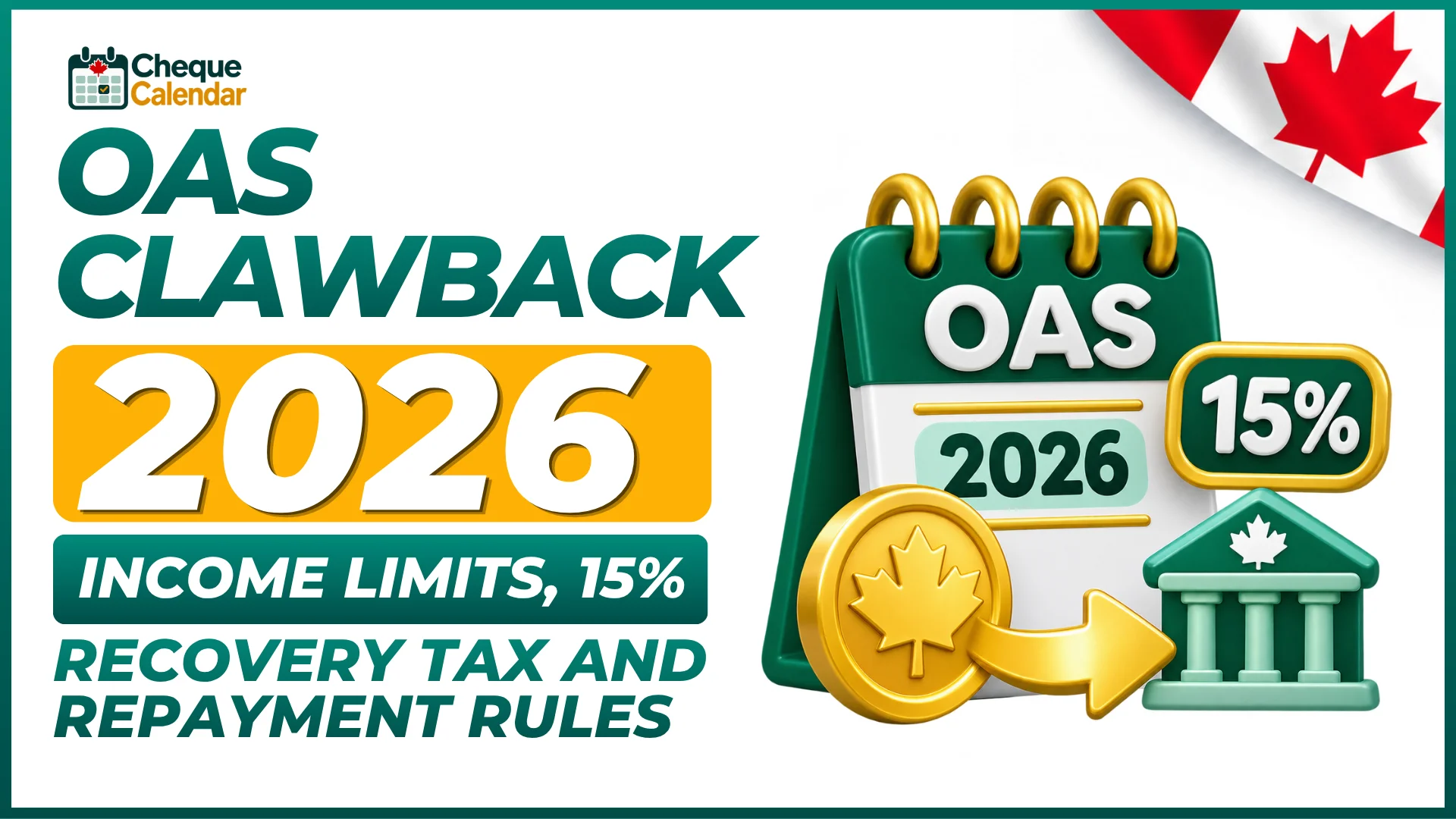
The OAS clawback 2026, officially known as the Old Age Security pension recovery tax, requires higher-income pension recipients to repay part or all of their OAS pension.
For the July 2026 to June 2027 recovery period, the income threshold is $93,454, based on your 2025 income. The recovery tax is generally calculated at 15% of applicable income above this threshold, subject to the amount of OAS received.
For the 2026 income year, the threshold increases to $95,323. This figure applies when calculating the recovery tax on 2026 income and determining subsequent monthly withholding from July 2027 to June 2028.
Understanding the difference between annual recovery tax and monthly pension deductions can help you estimate how much OAS you may need to repay.
This Cheque Calendar guide explains the official income limits, recovery tax calculations, monthly deductions, repayment rules and how to request reduced withholding if your income has fallen.
OAS Clawback 2026: Key Information at a Glance
The Canada Revenue Agency (CRA) and Service Canada use income information to determine whether an Old Age Security pension recipient must repay part of their pension.
| OAS Recovery Tax Information | Current Rules |
|---|---|
| Current recovery period | July 2026 to June 2027 |
| Relevant income year | 2025 |
| Minimum income threshold | $93,454 |
| Recovery tax rate | 15% |
| Full-recovery threshold, ages 65–74 | $152,062 |
| Full-recovery threshold, ages 75+ | $157,923 |
| Minimum threshold for 2026 income | $95,323 |
| Next recovery period | July 2027 to June 2028 |
| Collection method | Recovery tax withheld from monthly OAS payments where applicable |
The minimum threshold determines when recovery begins. The published maximum thresholds indicate the income levels at which maximum OAS pensions are fully recovered.
Official source: Old Age Security Pension Recovery Tax — Canada.ca.
OAS Clawback Income Thresholds for 2025, 2026 and 2027
One of the most common sources of confusion is the difference between the income year and the subsequent recovery period.
For example, monthly deductions from July 2026 through June 2027 are based on income reported for 2025.
The Government of Canada publishes the following thresholds.
| Recovery Period | Income Year | Minimum Income Threshold | Full Recovery: Age 65–74 | Full Recovery: Age 75+ |
|---|---|---|---|---|
| July 2025–June 2026 | 2024 | $90,997 | $148,451 | $154,196 |
| July 2026–June 2027 | 2025 | $93,454 | $152,062 | $157,923 |
| July 2027–June 2028 | 2026 | $95,323 | $155,320 | $161,320 |
Source: Government of Canada. Maximum thresholds for the current income year are estimates from January through September and become final from October through December.
Why Are There Two Different OAS Clawback Thresholds for 2026?
The $93,454 threshold applies to 2025 income and the monthly recovery period beginning in July 2026.
The $95,323 threshold applies to income earned during the 2026 calendar year.
If you are checking recovery tax currently withheld from your OAS payments between July 2026 and June 2027, use the $93,454 threshold.
If you are estimating your recovery tax for the 2026 income year, use the $95,323 threshold.
The subsequent monthly withholding period runs from July 2027 to June 2028.
How Is the OAS Clawback Calculated?
The OAS clawback is generally calculated at 15% of applicable income above the recovery threshold.
However, the recovery tax cannot exceed the applicable OAS benefits subject to repayment.
OAS Recovery Tax Formula
Step 1: Subtract the applicable income threshold from your relevant annual income.
Income above threshold = Applicable income − Recovery threshold
Step 2: Multiply the amount above the threshold by 15%.
Estimated recovery tax = Income above threshold × 15%
If your applicable income does not exceed the threshold, no recovery tax is payable under this calculation.
For Canadian income tax purposes, the CRA uses net income before adjustments as a starting point and applies the relevant social benefits repayment rules.
The simplified formula provides an estimate, while the applicable CRA worksheet determines your actual repayment.
OAS Clawback Example: $100,000 of 2025 Income
The Government of Canada provides an example using $100,000 of income for 2025.
Because the applicable recovery threshold is $93,454, the calculation is as follows:
| Calculation | Amount |
|---|---|
| Income for 2025 | $100,000 |
| Recovery threshold | $93,454 |
| Income above threshold | $6,546 |
| Recovery tax rate | 15% |
| Estimated OAS repayment | $981.90 |
The calculation is:
$100,000 − $93,454 = $6,546
$6,546 × 15% = $981.90
Assuming sufficient OAS benefits were received and no other adjustments apply, the estimated annual recovery tax is $981.90.
This amount is also used in the government’s example of monthly recovery tax withholding beginning in July 2026.
For your actual tax return, use the applicable CRA Federal Worksheet.
Official source: Repayment of Old Age Security Pension — Canada.ca.
How Much OAS Recovery Tax Is Deducted Each Month?
If you must repay part of your OAS pension, an appropriate amount may be withheld from your future monthly payments.
This spreads the withholding across the recovery period.
Using the government’s $981.90 example, the estimated monthly deduction is approximately $82.
Monthly Recovery Tax Example
| Item | Amount |
|---|---|
| Estimated annual recovery tax | $981.90 |
| Number of monthly deductions | 12 |
| Estimated monthly deduction | $81.83 |
| Approximate deduction in the government example | $82 |
| Recovery period begins | July 2026 |
| Recovery period ends | June 2027 |
Recipients receive an Advisory Letter explaining recovery tax deductions from their OAS payments.
Does the Government Deduct Recovery Tax Automatically?
Where recovery tax withholding applies, the government uses income information to determine the applicable deduction from future OAS payments.
However, monthly withholding and annual recovery tax liability are not exactly the same.
Monthly withholding is based on previous income information, while the final annual recovery tax is determined using the relevant tax year’s income.
Recovery tax already withheld is accounted for when you complete the applicable income tax return.
This means you may owe an additional amount or receive a credit or refund, depending on your overall tax assessment.
Review your Advisory Letter and tax slips to understand the amounts withheld.
Can the Entire Old Age Security Pension Be Recovered?
Yes. The OAS recovery tax can result in the repayment of your entire pension if your applicable income is sufficiently high.
For July 2026 to June 2027, the published full-recovery thresholds are:
| Recipient Age | Published Full-Recovery Income Threshold |
|---|---|
| Ages 65–74 | $152,062 |
| Age 75 or older | $157,923 |
These thresholds are based on maximum OAS pension amounts.
If you receive a partial OAS pension, your entire benefit may be recovered at a lower income level. Your individual recovery tax is limited to the applicable benefits subject to repayment.
Why Is the Full-Recovery Threshold Higher for People Aged 75 or Older?
Eligible OAS recipients aged 75 or older receive a higher maximum pension rate than recipients aged 65 to 74.
As a result, more pension income may be subject to recovery, producing a higher published full-recovery threshold.
However, both age groups use the same minimum recovery threshold for the applicable income year.
For the recovery period from July 2026 through June 2027, this minimum threshold is $93,454.
What Income Does the OAS Clawback Use?
For Canadian residents, the CRA uses the applicable net income calculation rather than examining only employment earnings.
Net income before adjustments, reported on line 23400 of your income tax return, is the starting point.
Income sources that may affect your OAS recovery tax include:
- Employment and self-employment income.
- CPP and QPP retirement pensions.
- OAS pension income.
- Taxable workplace pension income.
- RRSP and RRIF withdrawals.
- Taxable investment income.
- Taxable capital gains.
- Net rental income.
- Other applicable taxable income.
However, the CRA’s calculation may require specific adjustments to line 23400.
For example, certain Universal Child Care Benefit and Registered Disability Savings Plan income amounts and repayments are treated according to the applicable worksheet instructions.
Gross employment income alone does not determine your final OAS clawback.
Official source: CRA — Line 23500, Social Benefits Repayment.
2026 income threshold: $95,323
Find out how much additional applicable income you could receive before recovery begins.
| Annual income | Remaining income room |
|---|---|
| $80,000 | $15,323 |
| $85,000 | $10,323 |
| $90,000 | $5,323 |
| $95,000 | $323 |
| $100,000 | Above threshold |
Planning an RRSP withdrawal?
Taxable RRSP withdrawals may increase the income used to calculate your OAS recovery tax. Every additional $1,000 above the threshold could increase recovery tax by $150, until your recoverable OAS is exhausted.
What about TFSA withdrawals?
TFSA withdrawals are generally tax-free and do not affect federal income-tested benefits such as OAS.
Is OAS Included in Income for Recovery Tax Purposes?
Yes. Old Age Security pension payments are generally taxable income and form part of the relevant income calculation.
Therefore, you should not estimate your recovery tax using only your non-OAS earnings.
Use the applicable CRA worksheet to calculate your actual repayment.
Is the OAS Clawback Based on Household Income?
No. The OAS clawback is generally determined using the individual recipient’s applicable income rather than combined household income.
For married or common-law partners, each person’s tax return is considered separately.
However, applicable tax elections and income adjustments may affect the amounts reported on individual returns.
You should review your own tax information rather than automatically combining your income with your spouse’s income.
Where Is the OAS Recovery Tax Reported on Your Tax Return?
Understanding the relevant tax return lines and information slips can help you identify how recovery tax is calculated and reported.
| Tax Form or Line | What It Is Used For |
|---|---|
| Line 11300 | Reporting Old Age Security pension income |
| Line 23400 | Net income before adjustments |
| Line 23500 | Allowable social benefits repayment deduction |
| Line 42200 | Social benefits repayment included in tax payable |
| Line 43700 | Total income tax deducted, including applicable recovery tax already withheld |
| T4A(OAS), Box 22 | OAS recovery tax withheld |
| NR4-OAS, Box 27 | OAS recovery tax withheld for applicable non-resident reporting |
Why Does Line 23500 Matter?
Line 23500 is used for the allowable social benefits repayment deduction.
The actual calculation must follow the applicable CRA Federal Worksheet.
Do not simply enter 15% of your gross earnings above the threshold without checking the relevant tax instructions.
What Is the Difference Between Line 23500 and Line 43700?
Line 23500 relates to the allowable repayment deduction calculated for your tax return.
Line 43700 accounts for applicable income tax deductions already withheld.
If your T4A(OAS) slip shows recovery tax in box 22, the CRA instructs you to claim that withheld amount on line 43700.
The social benefits repayment calculation itself is reported through the relevant entries on lines 23500 and 42200.
Do not claim the recovery tax shown in box 22 as an unrelated deduction on line 23200.
Official source: CRA — Social Benefits Repayment.
What Happens If Your Income Falls After the Recovery Tax Was Calculated?
Your monthly OAS recovery tax deductions may be based on income from an earlier year.
For example, you may have earned a higher income in 2025 but retired or experienced a substantial income reduction in 2026.
As a result, monthly withholding may not accurately reflect your current financial circumstances.
The CRA provides a procedure for requesting reduced recovery tax withholding.
Requesting a Reduction With Form T1213(OAS)
If your 2025 income exceeded the recovery threshold but your 2026 income is expected to be substantially lower, you may submit a written request to reduce withholding.
The relevant government form is:
T1213(OAS) — Request to Reduce Old Age Security Recovery Tax at Source
You must complete the form and submit it to the CRA for review.
Submitting the form does not automatically guarantee approval. The CRA reviews the information provided before determining whether withholding can be reduced.
An approved reduction changes the amount withheld from your monthly payments. It does not automatically eliminate your final annual recovery tax liability.
Official form: Download Form T1213(OAS) — Canada.ca.
What If OAS Recovery Tax Deductions Cause Financial Hardship?
If recovery tax deductions create financial hardship, the Government of Canada advises that you may request a review of your circumstances through the CRA.
This provides an official route for pension recipients whose deductions are causing financial difficulties.
However, financial hardship does not automatically cancel the recovery tax.
If your income has fallen substantially, Form T1213(OAS) may also be relevant to your circumstances.
Contact the CRA for assistance with recovery tax calculations and requests for reduced withholding.
What Happens If You Receive OAS Outside Canada?
OAS recovery tax rules may differ for recipients living outside Canada.
Non-residents may be subject to Canadian non-resident tax, OAS recovery tax or both, depending on their income, country of residence and applicable international tax treaty.
For the 2025 income year, the relevant minimum recovery threshold is $93,454.
Non-resident recipients should review their net world income and any applicable treaty provisions before estimating recovery tax.
What Is Net World Income?
For non-resident OAS reporting, net world income generally includes income from Canadian and foreign sources after allowable deductions.
This may include employment income, pensions, business earnings, investment income and rental income.
Taxes already withheld should not be treated as an allowable reduction when calculating net world income for this purpose.
What Is the Old Age Security Return of Income?
The Old Age Security Return of Income (OASRI) is used to determine the recovery tax applicable to certain non-resident OAS recipients.
Recipients required to file generally receive the relevant income return and NR4-OAS information slip.
The NR4-OAS slip contains details of pension payments and applicable tax deductions for the previous year.
When Must the Old Age Security Return of Income Be Filed?
The required OASRI should be submitted by April 30.
For the 2025 income year, the filing deadline was April 30, 2026.
If you are required to file and the CRA does not receive your return, your OAS payments may be interrupted beginning in July.
Some non-resident pension recipients are exempt from filing under Canada’s international tax treaties.
The exemption depends on the country of residence and applicable conditions. Special circumstances, including changes in residence during the relevant period, may also affect the requirement.
Always check the CRA’s official country-specific exemption list before deciding whether you need to file.
What If Both Non-Resident Tax and OAS Recovery Tax Apply?
The combined recovery tax and non-resident tax cannot exceed the applicable OAS benefits received.
However, non-resident recipients should use the CRA’s dedicated OASRI recovery tax worksheet because additional calculation rules and treaty provisions may apply.
The simplified 15% recovery tax example in this article may not reflect your final non-resident tax liability.
Official source: Old Age Security Return of Income for Non-Residents — CRA.
How the OAS Clawback Thresholds Have Changed
The Government of Canada adjusts the minimum recovery threshold over time.
Comparing the income years helps explain why different websites may display different OAS clawback figures.
| Income Year | Minimum OAS Recovery Threshold | Corresponding Recovery Period |
|---|---|---|
| 2024 | $90,997 | July 2025–June 2026 |
| 2025 | $93,454 | July 2026–June 2027 |
| 2026 | $95,323 | July 2027–June 2028 |
The higher threshold does not automatically mean that every recipient will pay less recovery tax.
Your actual repayment depends on your applicable income and OAS entitlement.
What Has Changed in the Latest Government Information?
The Government of Canada has published the income thresholds for the recovery period from July 2027 through June 2028.
For the 2026 income year, the published figures are:
- Minimum recovery threshold: $95,323.
- Full-recovery threshold for ages 65–74: $155,320.
- Full-recovery threshold for ages 75 and older: $161,320.
These figures apply to the specified income year and recovery period.
They do not replace the $93,454 threshold applicable to current monthly withholding from July 2026 through June 2027.
Always refer to the official government recovery tax table for the latest information.
Common OAS Clawback Misunderstandings
Several distinctions are important when reviewing your pension entitlement and recovery tax.
The 15% Recovery Rate Is Not Your Regular Income Tax Rate
The recovery tax uses a 15% rate on applicable income above the threshold.
This is separate from the ordinary income tax calculation, although both are accounted for through the relevant tax reporting process.
The Maximum Recovery Threshold Is Not the Starting Threshold
For July 2026 to June 2027, recovery begins above $93,454 of applicable 2025 income.
The higher published thresholds of $152,062 and $157,923 indicate full recovery of maximum OAS pensions for the respective age groups.
Partial recovery can begin well below those amounts.
Monthly Withholding Does Not Mean the Threshold Is Monthly
The minimum recovery threshold is an annual income figure.
Although recovery tax may be withheld from monthly payments, there is no separate monthly income threshold replacing the annual threshold.
The Income Year Is Not Always the Deduction Year
The recovery period beginning in July 2026 uses income from 2025.
The recovery period beginning in July 2027 uses income from 2026.
Always identify the relevant income year when comparing information about OAS clawback 2026.
Reduced Withholding Does Not Automatically Eliminate Recovery Tax
The CRA may approve a request to reduce the amount withheld from your monthly pension.
However, your final annual recovery tax still depends on your applicable income and the relevant tax rules. Use our CPP Calculator 2026 to estimate your CPP retirement income and understand how it may affect your OAS recovery tax.
How to Check Your Own OAS Recovery Tax
If your OAS payment is lower than expected or you want to understand your recovery tax, follow these steps:
- Review your relevant income tax return.
- Identify the applicable income year and recovery threshold.
- Check your Advisory Letter for monthly recovery tax deductions.
- Review your T4A(OAS) or NR4-OAS information slip.
- Use the applicable CRA worksheet to calculate your repayment.
- Contact the CRA if the calculation or withholding is unclear.
If you are a non-resident, consult the separate OASRI filing and calculation requirements.
For OAS payment information, you can also access My Service Canada Account.
Official CRA Contact Information
The Government of Canada’s OAS recovery tax guidance lists the following contact numbers.
| Location or Service | Telephone Number |
|---|---|
| Canada and United States | 1-800-959-8281 |
| Outside Canada and United States | 613-940-8495 |
| TTY | 1-800-665-0354 |
Contact the CRA for recovery tax and tax reporting questions.
For pension payment enquiries, contact Service Canada.
Check the official CRA contact page before calling, as contact arrangements may change.
Frequently Asked Questions About OAS Clawback 2026
1. What Is the OAS Clawback in Canada?
The OAS clawback is the recovery tax applied to Old Age Security pension recipients whose applicable income exceeds the government threshold.
The recovery tax is generally 15% of income above the threshold, limited to the applicable benefits subject to repayment.
2. What Is the OAS Clawback Threshold for 2026?
For monthly deductions between July 2026 and June 2027, the threshold is $93,454, based on 2025 income.
For the 2026 income year, the threshold is $95,323. This income year is associated with the subsequent monthly recovery period beginning in July 2027.
3. What Percentage of Income Above the OAS Threshold Is Repaid?
The recovery rate is 15% of applicable income above the relevant threshold.
The actual repayment is subject to the applicable OAS benefits received and CRA calculation rules.
4. How Much OAS Is Repaid on $100,000 of 2025 Income?
Using the 2025 threshold of $93,454, the income above the threshold is $6,546.
Applying the 15% recovery rate results in an illustrative repayment of $981.90, assuming sufficient OAS benefits and no other applicable adjustments.
5. Is the OAS Clawback Automatically Deducted From Monthly Payments?
Recovery tax may be withheld from future monthly OAS pension payments.
For example, the government’s estimated annual recovery amount of $981.90 corresponds to monthly withholding of approximately $82.
The recipient receives an Advisory Letter explaining the applicable deductions.
6. Can the Government Recover My Entire OAS Pension?
Yes. For July 2026 to June 2027, the published full-recovery thresholds are $152,062 for ages 65–74 and $157,923 for ages 75 and older.
Recipients with partial OAS pensions may experience full recovery at lower income levels.
7. What Is the OAS Clawback Threshold Based on 2026 Income?
The minimum recovery threshold for the 2026 income year is $95,323.
The published maximum recovery thresholds are $155,320 for ages 65–74 and $161,320 for ages 75 and older.
The corresponding monthly recovery period runs from July 2027 to June 2028.
8. Why Is My OAS Payment Lower Than Expected?
Recovery tax withholding is one possible reason for a lower OAS payment.
Other tax deductions or payment adjustments may also affect your pension.
Review your Advisory Letter, tax slips and payment information through My Service Canada Account before determining the cause.
9. Where Can I See OAS Recovery Tax on My Tax Slip?
Recovery tax withheld is reported in box 22 of the T4A(OAS) slip or box 27 of the NR4-OAS slip, as applicable.
For Canadian income tax returns, qualifying amounts already withheld are accounted for on line 43700.
10. Which Tax Return Lines Are Used for OAS Clawback?
Relevant tax return lines include 11300, 23400, 23500, 42200 and 43700.
Each line has a different purpose. Use the applicable CRA Federal Worksheet to calculate the correct amounts.
11. Can I Request Lower Monthly OAS Recovery Tax Deductions?
Yes. If your current income is expected to be substantially lower than your previous income, you may request reduced withholding using Form T1213(OAS).
The CRA reviews your request, and approval is not guaranteed.
12. What If OAS Recovery Tax Deductions Cause Financial Hardship?
You may ask the CRA to review your financial circumstances.
However, financial hardship does not automatically cancel the recovery tax or guarantee reduced withholding.
13. Do OAS Clawback Rules Apply to Canadians Living Outside Canada?
Some non-resident OAS recipients are subject to recovery tax.
The applicable treatment depends on net world income, residence, non-resident tax rules and international tax treaties.
Consult the CRA’s dedicated non-resident guidance for your circumstances.
14. What Is the Old Age Security Return of Income?
The Old Age Security Return of Income is used to determine applicable recovery tax for certain non-resident OAS recipients.
Individuals required to file should follow the official OASRI instructions and use their NR4-OAS information slip.
15. What Happens If I Do Not File the Required OAS Return of Income?
The required OASRI must generally be submitted by April 30.
Failure to submit the required return may result in an interruption of OAS payments beginning in July.
Some recipients qualify for tax treaty exemptions, subject to country-specific requirements and other conditions.
16. Is OAS Clawback the Same as Regular Income Tax?
No. OAS is generally taxable income, but the recovery tax is a separate repayment mechanism.
The recovery tax applies when relevant income exceeds the applicable threshold and is accounted for through the appropriate tax return process.
17. Does My Spouse’s Income Automatically Count Towards My OAS Clawback?
No. Recovery tax is generally based on your individual applicable income rather than combined household income.
However, applicable tax elections and income adjustments may affect the income reported on your individual return.
18. Where Can I Check My OAS Recovery Tax?
Review your Advisory Letter, relevant income tax return and OAS information slip.
For personal pension payment information, use My Service Canada Account.
For recovery tax calculations, reduced withholding requests or tax reporting questions, consult the CRA’s official guidance.
Official Government Sources
The following official Government of Canada resources support the income thresholds, calculations, reporting requirements and repayment procedures discussed in this article.
- Old Age Security Pension Recovery Tax — Canada.ca
- Repayment of Old Age Security Pension — Canada.ca
- Line 23500: Social Benefits Repayment — CRA
- Line 11300: Old Age Security Pension — CRA
- Form T1213(OAS): Request to Reduce Old Age Security Recovery Tax at Source
- Old Age Security Return of Income for Non-Residents — CRA
- Old Age Security Pension — Canada.ca
- My Service Canada Account
- Contact the Canada Revenue Agency
Final Summary: What the OAS Clawback Means in 2026
The OAS clawback 2026 requires higher-income pension recipients to repay part or all of their Old Age Security pension when applicable income exceeds the government threshold.
For monthly recovery tax withholding from July 2026 through June 2027, the minimum threshold is $93,454, based on 2025 income.
For income earned in 2026, the threshold increases to $95,323, with the subsequent monthly recovery period beginning in July 2027.
The general recovery rate remains 15% of applicable income above the relevant threshold, subject to the benefits that can be recovered.
If your income has fallen substantially or recovery tax deductions are causing financial hardship, contact the CRA to discuss the available review and reduced-withholding procedures.
Most importantly, review your official income records, Advisory Letter and CRA calculation instructions rather than relying on gross earnings or published thresholds alone.
Disclaimer: Cheque Calendar is an independent informational website and is not affiliated with the Government of Canada, the Canada Revenue Agency or Service Canada. This article provides general information and does not constitute financial, legal or tax advice. Calculations are illustrative and do not guarantee individual tax liabilities or pension amounts. Always confirm your circumstances through official government sources.
2 thoughts on “OAS Clawback 2026: Income Limits, 15% Recovery Tax and Repayment Rules”
Comments are closed.