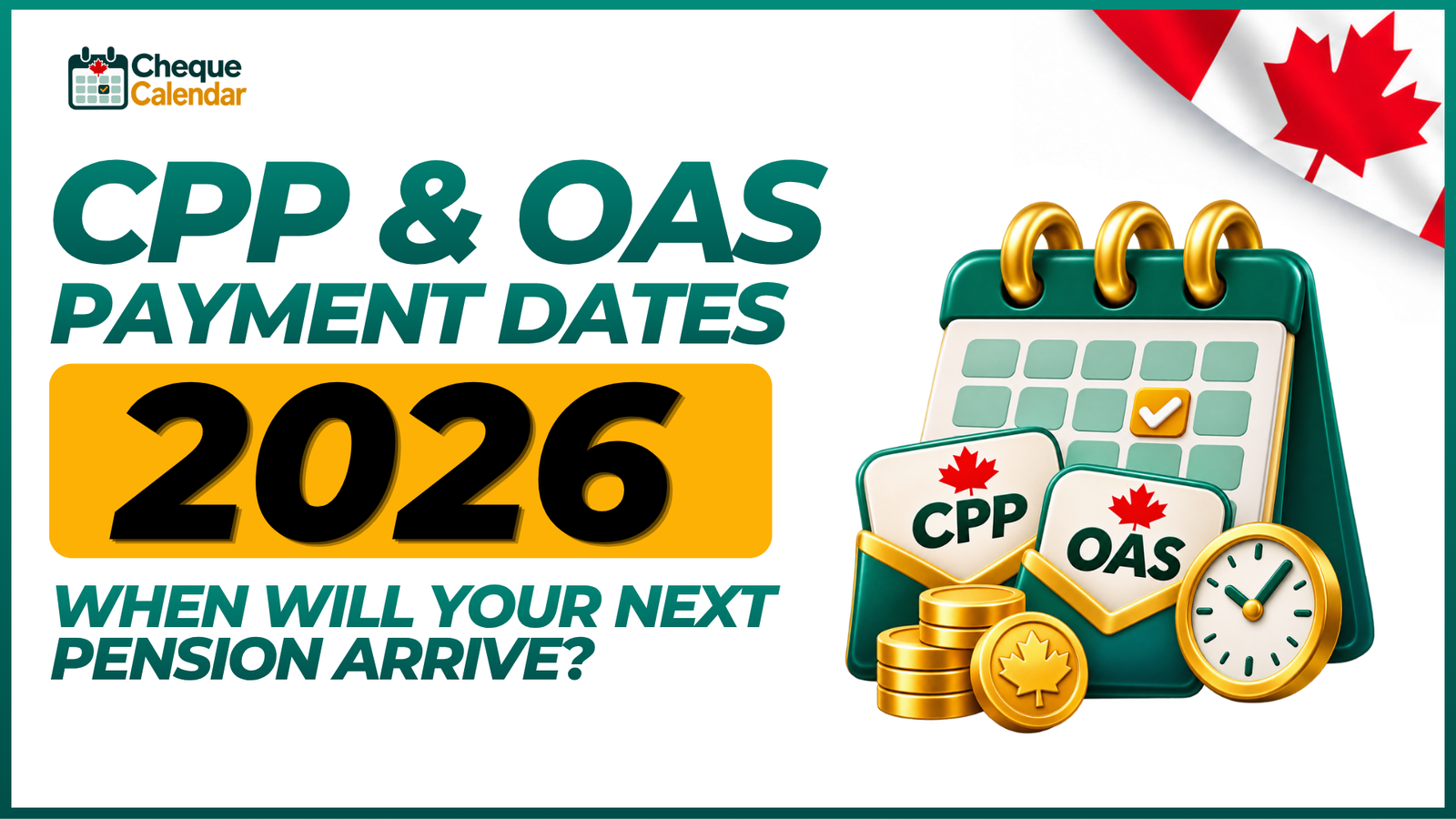
CPP payments for November 2026 are scheduled for Thursday, November 26, followed by the final pension payment of the year on Tuesday, December 22, 2026. Old Age Security (OAS) payments follow the same official monthly schedule.
Although CPP and OAS share identical payment dates, both pension programs have different eligibility requirements and benefit calculations. The Government of Canada has also confirmed the complete 2027 payment schedule, helping seniors plan their retirement finances in advance.
This guide explains everything you need to know about CPP payments, including the official payment schedule, maximum monthly pension amounts, eligibility requirements, annual increases and what to do if your pension payment is delayed.
When Are CPP and OAS Payments Coming in 2026?
The Government of Canada has confirmed all 12 payment dates for 2026. CPP and OAS follow the same schedule, with payments generally issued toward the end of each month.
Here is the complete calendar for both programmes.
| Month | CPP Payment Date | OAS Payment Date |
| January | January 28, 2026 | January 28, 2026 |
| February | February 25, 2026 | February 25, 2026 |
| March | March 27, 2026 | March 27, 2026 |
| April | April 28, 2026 | April 28, 2026 |
| May | May 27, 2026 | May 27, 2026 |
| June | June 26, 2026 | June 26, 2026 |
| July | July 29, 2026 | July 29, 2026 |
| August | August 27, 2026 | August 27, 2026 |
| September | September 25, 2026 | September 25, 2026 |
| October | October 28, 2026 | October 28, 2026 |
| November | November 26, 2026 | November 26, 2026 |
| December | December 22, 2026 | December 22, 2026 |
Source: Government of Canada — Benefits Payment Dates.
The final two dates are particularly important for recipients planning their expenses around the holidays. However, a scheduled payment date does not always mean that a cheque will arrive in the mail that day.
Why Is the December 2026 Pension Payment Earlier?
The December CPP and OAS payment is scheduled for December 22, earlier in the month than most other pension payments.
As a result, the interval between the December 2026 payment and the first payment in January 2027 is longer than a typical monthly interval.
Recipients who use their pension to cover rent, utilities, groceries, or other essential expenses may find it helpful to plan around this longer gap.
Do CPP and OAS Payments Always Arrive Together?
CPP and OAS share the same scheduled payment dates in 2026. However, they are separate pension programmes, so receiving both does not mean that the benefits are combined into one payment.
The time deposits appear can also vary depending on the recipient’s payment method and financial institution.
Service Canada advises that payments may take a few days to arrive, particularly when they are issued by cheque.
How Much CPP Can You Receive Each Month in 2026?
The maximum new CPP retirement pension at age 65 is $1,507.65 per month in January 2026. However, this amount is not automatically paid to everyone who qualifies.
Your pension depends on how much and how long you contributed to CPP, your earnings during your working life, and the age at which you begin receiving payments.
The government publishes average and maximum CPP amounts to help recipients understand the difference between typical payments to new beneficiaries and the highest available amounts.
| CPP Retirement Pension | Monthly Amount | Reference Period |
| Maximum at age 65 | $1,507.65 | January 2026 |
| Average for new beneficiaries at age 65 | $858.34 | July 2026 |
Source: Canada Pension Plan Monthly Payment Amounts.
Canada
The average figure applies to new beneficiaries in the specified reporting period. It should not be treated as the average payment received by every existing CPP pensioner.
Why Do Some Canadians Receive Less Than the Maximum CPP?
CPP is based primarily on contributions rather than simply reaching retirement age.
Someone who made contributions over many years at higher pensionable earnings may receive a different amount from someone with a shorter contribution record.
Starting CPP before age 65 also reduces the monthly amount, while delaying it can increase the payment. Certain child-rearing and disability provisions may also affect the calculation under government rules.
To see your personal estimate and contribution record, visit My Service Canada Account.
Will CPP Payments Increase Again?
CPP benefits are adjusted annually to reflect changes in the Consumer Price Index (CPI).
For January to December 2026, the government confirmed a 2.0% adjustment to CPP benefits paid in 2025. The adjustment takes effect each January rather than every quarter.
Therefore, recipients should not assume that an announced OAS quarterly increase also applies to CPP. The two programmes follow different adjustment schedules.
Canada
How Much OAS Will Seniors Receive in November and December 2026?
The maximum monthly Old Age Security pension for October through December 2026 is $762.50 for people aged 65 to 74 and $838.75 for people aged 75 and older.
These are the published maximum amounts for the current quarter. A recipient’s actual OAS pension may be lower depending on Canadian residence history, income, and other applicable rules.
| Age Group | Maximum Monthly OAS | Applicable Period |
| Ages 65–74 | $762.50 | October–December 2026 |
| Ages 75 and older | $838.75 | October–December 2026 |
Source: Official OAS Payment Amounts and Income Thresholds.
Canada
Why Is OAS Higher for Seniors Aged 75 and Older?
The Government of Canada introduced a permanent 10% increase in the OAS pension for eligible seniors aged 75 and older in July 2022.
Consequently, the maximum pension for this age group is higher than the maximum for recipients aged 65 to 74.
The increase applies under the programme’s rules and does not mean that every person aged 75 or older receives the full maximum payment.
How Much Did OAS Increase in October 2026?
OAS benefit rates increased by 1.4% for the October to December 2026 quarter.
According to the government, this represents a 3.0% increase over the 12-month period from October 2025 to October 2026.
OAS rates are reviewed four times a year: January, April, July, and October. If the cost of living falls, the programme’s indexed payment rates do not decrease because of that decline.
Canada
Who Qualifies for CPP and OAS in Canada?
CPP and OAS have different eligibility requirements because they are designed around different principles.
CPP is tied primarily to pension contributions. OAS, by contrast, is based on age, legal status, Canadian residence, and applicable income rules.
Can You Receive CPP at Age 60?
Yes. You can qualify for a CPP retirement pension from age 60 if you have made at least one valid CPP contribution.
The standard starting age is 65, but eligible individuals may choose to begin receiving payments earlier or later.
Under the government’s rules, starting CPP before 65 reduces the pension by 0.6% for each month before that age, up to a maximum reduction of 36% at age 60.
Delaying CPP after age 65 increases the monthly amount by 0.7% for each month of delay, up to a maximum increase of 42% at age 70.
Canada+1
These adjustments affect the monthly pension amount. They do not change the government’s published monthly payment calendar.
Can You Receive OAS Without Ever Working in Canada?
Yes. OAS does not require employment contributions in the way CPP does.
A person living in Canada generally needs to be at least 65 years old, be a Canadian citizen or legal resident when the application is approved, and have lived in Canada for at least 10 years after turning 18.
For applicants living outside Canada, the ordinary residence requirement is at least 20 years after age 18, together with the applicable citizenship or legal-status requirement.
Special circumstances and international social security agreements may affect eligibility.
Could You Qualify for OAS?
Select where you live to explore the normal age and residence requirements.
In Canada after turning 18
In Canada after turning 18
Can You Collect Both CPP and OAS at the Same Time?
Yes. Canadians who meet the separate eligibility rules can receive both pensions.
CPP payments do not automatically disqualify someone from receiving OAS. However, pension income can affect income-tested benefits such as the Guaranteed Income Supplement (GIS).
For that reason, recipients should distinguish eligibility for a basic pension from eligibility for additional income-tested support.
Are CPP and OAS Payment Dates for 2027 Available?
Yes. The Government of Canada has now published the complete CPP and OAS payment calendar for 2027.
Earlier articles stating that the 2027 dates were unannounced are outdated. The official calendar confirms that both programmes will begin their 2027 payments on January 27.
The full schedule is shown below.
| Month | CPP and OAS Payment Date 2027 |
| January | January 27, 2027 |
| February | February 24, 2027 |
| March | March 25, 2027 |
| April | April 28, 2027 |
| May | May 27, 2027 |
| June | June 28, 2027 |
| July | July 28, 2027 |
| August | August 27, 2027 |
| September | September 27, 2027 |
| October | October 27, 2027 |
| November | November 26, 2027 |
| December | December 22, 2027 |
These dates are published on the official Canada.ca benefits calendar.
Canada
Although the 2027 dates are confirmed, this does not establish the amount each person will receive in 2027. Pension amounts and payment dates must be checked separately.
How Can You Check Your CPP or OAS Payment Status?
The most reliable way to check personal pension information online is through My Service Canada Account (MSCA).
This government service provides access to CPP and OAS information, including available pension records, payment details, and account services.
How Do You Check Your Payment Online?
To review your pension information:
- Visit the official My Service Canada Account website.
- Sign in using one of the available government-approved methods.
- Select the relevant CPP or OAS section.
- Review your available payment or pension information.
- Check whether your mailing address and banking details are accurate.
If you are not yet receiving a pension, you can also use the appropriate government programme pages to review application requirements.
Do You Need to Apply Separately for CPP and OAS?
Generally, CPP retirement pensions require an application. Service Canada allows eligible individuals to apply up to 12 months before their chosen CPP pension start date.
OAS operates differently. Service Canada may automatically enrol eligible people when it has enough information to determine their entitlement.
If you have not received an OAS enrolment letter within one month after your 64th birthday, you may need to apply. The government recommends checking your enrolment status rather than assuming payments will begin automatically.
Canada+1
What Should You Do if Your CPP or OAS Payment Is Late?
If your CPP or OAS payment does not arrive on the scheduled date, check your payment information before assuming that your benefits have stopped.
The Government of Canada explains that payments may take a few days to arrive. It advises recipients to wait 5 to 10 business days before contacting the relevant programme about a missing payment.
Where Is My CPP or OAS Payment?
Complete these checks before contacting Service Canada.
Payment Troubleshooting Checklist
A payment not arriving on the scheduled day does not necessarily mean your benefits have stopped. Payments may take a few days to arrive. If the payment remains missing after the government’s recommended waiting period, contact the relevant program using official channels.
What if I receive a paper cheque?
Mailed cheques may take longer than direct deposit. Check your mailing address and allow for delivery.
What if my banking details changed?
Review the official direct-deposit update process. Never share banking details through unexpected emails, text messages or unofficial websites.
Does this tool check my payment status?
No. This checklist provides general information. It cannot access your bank account, personal benefit status or Service Canada records.
Canada
How Can You Find Out Why a Payment Is Missing?
Begin by checking the official payment date. You may have been expecting the deposit on a different day based on an earlier month’s schedule.
Next, review your bank transactions and confirm that Service Canada has the correct information.
If you receive your pension by cheque, allow additional time for postal delivery.
If the payment remains missing after the recommended waiting period, contact Service Canada using the contact information available on Canada.ca.
Can Incorrect Banking Information Delay a Pension?
Yes. Incorrect or outdated direct deposit information can interfere with successful payment delivery.
For example, changes to a registered bank account may require updated information before future payments can be processed correctly.
Recipients should use official government services to make changes and should never provide banking details through unexpected text messages or suspicious websites.
Does Living in Quebec or Outside Canada Change Your Pension?
A person’s province of employment or country of residence can affect how pension rules apply.
What Happens if You Worked in Quebec?
Quebec operates the Quebec Pension Plan (QPP), which is separate from CPP.
The two programmes work together for people who have contributed in different parts of Canada.
If you worked only in Quebec, or have a combination of Quebec and CPP contributions, the applicable pension arrangements may differ. Retraite Québec and Service Canada provide guidance for these situations.
Canada
Can You Receive CPP While Living Abroad?
CPP retirement pensions can generally be paid to eligible recipients living outside Canada.
OAS has more specific residence-related conditions, particularly concerning continued payments abroad.
Someone who has lived and worked in another country may also be affected by an international social security agreement.
These agreements can sometimes help determine eligibility where a person has not accumulated enough residence or contribution periods under ordinary rules.
Canada
Frequently Asked Questions About CPP and OAS Payments 2026
1. What is the next CPP payment date in November 2026?
The next Canada Pension Plan payment is scheduled for Thursday, November 26, 2026.
This date applies to the CPP retirement pension and other CPP benefits included in the government’s payment calendar, such as disability, survivor, and children’s benefits.
If you receive your pension through direct deposit, check your registered bank account. However, the government advises that payments may take a few days to appear.
2. When will seniors receive their December 2026 CPP and OAS payments?
Both CPP and OAS payments are scheduled for Tuesday, December 22, 2026.
This is earlier in the month than most scheduled pension payments. It also means there is a longer gap before the next payment, scheduled for January 27, 2027.
Recipients who depend on monthly pension payments should use the official dates when planning their regular expenses.
3. Why did my CPP or OAS payment not arrive on the scheduled date?
A missing payment does not necessarily mean your pension has been cancelled.
Possible explanations include postal delivery time, processing delays, or outdated banking information. The government notes that payment delivery can take several days after the scheduled issue date.
First, confirm the official date and review your account. If the payment remains missing, Canada.ca advises waiting 5 to 10 business days before contacting the relevant programme.
4. Can I receive CPP and OAS in the same month?
Yes. Eligible Canadians can receive both CPP and OAS during the same month.
CPP is mainly based on contributions made during working years, while OAS depends on age, Canadian residence, and other eligibility conditions.
Both benefits use the same official monthly payment dates. However, they remain separate pension programmes, and eligibility for one does not automatically establish entitlement to the other.
5. What is the maximum CPP retirement pension in 2026?
The maximum new CPP retirement pension at age 65 is $1,507.65 per month for January 2026.
However, the maximum is not the amount automatically paid to all retirees. A person’s actual CPP payment depends on contribution history, earnings, and the age at which they begin receiving the pension.
The government also reported an average of $858.34 for new retirement beneficiaries at age 65 in July 2026. That average represents a specific group of new recipients rather than everyone already receiving CPP.
6. How much OAS will people aged 65 to 74 receive in December 2026?
The maximum OAS pension for recipients aged 65 to 74 is $762.50 per month for October to December 2026.
This is the maximum amount for the specified quarter, not a guaranteed payment for everyone in that age group.
Someone with a shorter Canadian residence history may receive a partial pension. Income-related rules can also affect the amount ultimately received.
7. How much OAS will seniors aged 75 and older receive?
For October to December 2026, the maximum monthly OAS pension for eligible seniors aged 75 and older is $838.75.
The higher amount reflects the permanent 10% OAS increase introduced for this age group in July 2022, along with subsequent applicable adjustments.
However, the full amount depends on the recipient’s individual circumstances, including residence history and income.
8. Does CPP increase automatically every year?
CPP benefits are reviewed annually and adjusted according to the Consumer Price Index under the programme’s rules.
For 2026, CPP benefits paid in 2025 received a 2.0% adjustment.
The annual adjustment is different from the quarterly review used for OAS. Therefore, an OAS increase announced for a particular quarter should not be interpreted as an equivalent CPP increase.
Canada
9. How often does Old Age Security increase?
OAS payment rates are reviewed four times a year: January, April, July, and October.
For the October to December 2026 quarter, the government confirmed a 1.4% increase compared with the previous quarter.
The adjustments are based on changes in the Consumer Price Index. Under the programme’s indexing rules, OAS payment rates do not decrease when the cost of living falls. Use our Old Age Security Benefits Estimator 2026 guide to understand your potential OAS pension and other retirement benefits.
10. Can I receive CPP before turning 65?
Yes. Eligible contributors can begin CPP retirement payments as early as age 60.
However, starting before the standard age of 65 results in a permanent reduction to the monthly pension relative to the amount available at 65.
A person starting CPP at age 60 faces a reduction of up to 36%. By contrast, delaying CPP until age 70 can increase the monthly amount by up to 42% compared with starting at 65.
11. Can I receive OAS before age 65?
No. The earliest standard age for receiving the OAS pension is 65.
However, certain other programmes under the OAS system, including the Allowance and Allowance for the Survivor, may be available to eligible people aged 60 to 64.
These benefits have separate income, residence, and personal circumstances requirements. They should not be confused with the regular OAS pension.
12. Can I continue working while collecting CPP?
Yes. Working while receiving a CPP retirement pension does not automatically reduce that pension.
In certain circumstances, people who continue contributing to CPP while collecting their retirement pension may qualify for the CPP Post-Retirement Benefit.
These additional benefits are governed by age and contribution requirements. Service Canada provides more details on its CPP eligibility and working-while-receiving-CPP page.
13. Do I need to work in Canada to qualify for OAS?
No. OAS does not require a record of employment contributions.
Eligibility is mainly based on age, Canadian residence, citizenship or legal residency status, and other applicable conditions.
For someone living in Canada, the ordinary minimum residence requirement is 10 years after age 18. For applicants living outside Canada, the usual requirement is 20 years, although special rules and agreements may apply.
14. Will CPP or OAS payments stop if I leave Canada?
The answer depends on the benefit and your circumstances.
CPP retirement pensions can generally continue to eligible recipients living outside Canada.
OAS payments abroad are subject to residence requirements. A person with at least 20 years of Canadian residence after age 18 can generally continue receiving OAS abroad, while other situations may involve special rules.
GIS and the Allowance benefits have additional restrictions because they are primarily intended for eligible residents of Canada.
For details, consult Government of Canada — Living Outside Canada and Pension Eligibility.
15. Is the Guaranteed Income Supplement paid on the same date as OAS?
Yes. GIS follows the official OAS payment schedule.
GIS is designed to provide additional income support to eligible low-income OAS pensioners living in Canada.
Unlike the basic OAS pension, GIS is income-tested and is not taxable. The amount may change based on annual income information and household circumstances.
16. Can my OAS payment be reduced because of income?
Yes. OAS is subject to income-related rules, including the OAS recovery tax.
Higher-income recipients may have to repay some or all of their OAS pension through the applicable tax system.
However, the amount affected depends on the relevant income year and government thresholds. Recipients should consult the official OAS payment amounts page for the limits that apply to their circumstances.
17. Are the CPP and OAS payment dates for 2027 officially confirmed?
Yes. The Government of Canada has published all 12 CPP and OAS payment dates for 2027.
The first scheduled payment is January 27, 2027, and the last is December 22, 2027.
The dates are confirmed on Canada.ca. However, the publication of a payment calendar does not establish each recipient’s 2027 pension amount.
18. How can I check how much CPP or OAS I will personally receive?
You can review available pension information through My Service Canada Account.
CPP recipients can access information about their contributions and pension estimates. OAS recipients can review available programme services and check government guidance about payment amounts.
The published maximum amounts are useful reference figures, but your personal entitlement may differ. For that reason, an individual account or official Service Canada assessment is more reliable than a general online estimate.
Where Can You Find Official CPP and OAS Information?
The Government of Canada is the primary source for CPP and OAS payment schedules, eligibility rules, and benefit amounts.
These official resources provide the information used in this guide:
- Government of Canada — Benefits Payment Dates
- Canada Pension Plan — Retirement Pension Overview
- CPP Monthly Payment Amounts
- CPP Eligibility Requirements
- Old Age Security — Programme Overview
- Old Age Security Payment Amounts
- OAS Eligibility Requirements
- My Service Canada Account
What Should CPP and OAS Recipients Remember?
The two remaining CPP and OAS payments for 2026 are scheduled for November 26 and December 22. Service Canada has also confirmed the full 2027 payment calendar.
However, knowing the payment dates is only one part of understanding these benefits. CPP amounts depend mainly on contributions and starting age, while OAS payments are affected by age, Canadian residence, and income.
Recipients should check official government sources for current payment amounts, eligibility information, and account-specific details. This is especially important when reviewing figures that apply to a particular month, quarter, or calendar year.
For payment problems, begin with the official benefits calendar and your registered information before contacting Service Canada.
Cheque Calendar is an independent website and is not affiliated with the Government of Canada. This page is general information, not financial, legal or tax advice. Dates and amounts are taken from the Government of Canada sources linked above; always confirm your own payments in My Service Canada Account or your CRA account.